
This Application Note illustrates the possibilities of the Agilent 1290 Infinity LC system and the Agilent 6460A Triple Quadrupole Mass Spectrometer for quantitative analysis of poten- tial genotoxic impurities (PGIs) in active pharmaceutical ingredients (APIs). A generic approach was used to determine arylamine and aminopyridine PGIs in selected APIs. The influence of column length and mobile phase composition on the recovery of these impuri- ties in real samples were investigated. High resolution UHPLC using a 150 mm RRHD col- umn packed with 1.8 µm particles resulted in the best overall performance. In cases of good separation between API and the target solutes, analysis speed and sample throughput could be increased using a 50 mm RRHD column. Detection limits were below 20 ppb (ng/g, relative to the API) using MS/MS and below 100 ppb (ng/g, relative to the API) with DAD for 2,6-dichloroaniline, which could not be detected with ESI-MS at trace levels.
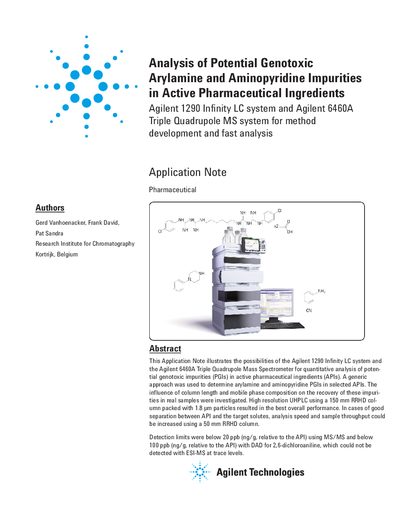
This document details a generic approach for the quantitative analysis of potential genotoxic impurities (PGIs), specifically arylamines and aminopyridines, in active pharmaceutical ingredients (APIs). It highlights the capabilities of the Agilent 1290 Infinity UHPLC system combined with an Agilent 6460A Triple Quadrupole Mass Spectrometer for detecting these impurities at trace levels, often below 20 ppb.
The note covers method development, including the optimization of column length (50, 100, or 150 mm) and mobile phase composition to balance recovery, separation, and analysis speed. It provides specific experimental parameters for the LC-MS/MS method, including MRM transitions and collision energies for ten specific impurities, and outlines the sample preparation procedure for four selected APIs.
| Column | Agilent ZORBAX Eclipse Plus C18 RRHD, 50, 100 or 150 mm x 2.1 mm id, 1.8 um |
|---|---|
| Mobile phase A | 0.05% formic acid in water |
| Flow rate | 0.5 mL/min |
| Injection volume (MS) | 1 uL |
| Detection limits (MS/MS) | Below 20 ppb (ng/g, relative to the API) |
| Detection limits (DAD) | Below 100 ppb (ng/g, relative to the API) |
The Agilent 1290 Infinity LC system and the Agilent 6460A Triple Quadrupole MS system.
A 150 mm RRHD column packed with 1.8 um particles resulted in the best overall performance.
Yes, analysis speed and sample throughput could be increased using a 50 mm RRHD column in cases of good separation.