
This document is an application compendium on analyzing and identifying impurities in drug substances using Agilent instrumentation. It provides guidance on improving overall workflow with Agilent products and applications. The compendium includes application notes on analyzing organic impurities with various Agilent LC and GC systems, analyzing residual solvents, analyzing inorganic impurities with ICP-MS, and determining impurities with LC/MS. Agilent's reliable instrumentation and services, including instrument qualification and diagnostic programs, ensure accurate and dependable impurity analysis. The analysis of impurities in drug substances is becoming increasingly challenging, from initial screening to routine quality control and assurance. Impurities are addressed from chemical aspects, including classification and identification.
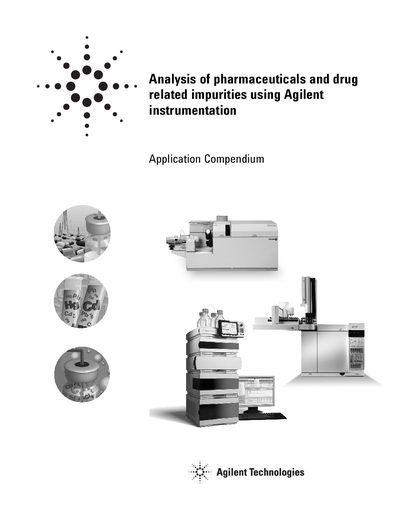
This document serves as an Application Compendium providing guidance on improving workflows for analyzing and identifying impurities in drug substances and biologics. It covers the full spectrum of impurity analysis, from initial screening to validated methods for routine quality control and assurance, addressing both chemical and safety aspects required by regulatory bodies like the US FDA and EMEA.
The compendium aggregates various application notes demonstrating the use of specific Agilent product portfolios. These include the Agilent 1120 Compact LC, 1200 Series LC, 1290 Infinity LC system, 7100 Capillary Electrophoresis system, 6890 and 7890 Series GCs, 5975 Series GC/MS, 7700 ICP-MS, and the 6000 Series LC/MS portfolio. Topics range from organic and inorganic impurity analysis to residual solvent determination and metabolite identification.
The document addresses organic impurities, inorganic impurities, and residual solvents.
Residual solvents are analyzed using the Agilent 6890 and 7890 Series GCs as well as the Agilent 5975 Series GC/MS.
Metabolites are identified using Agilent MassHunter Metabolite Identification software.