
Fast LC methods can help to increase sample throughput significantly without compromising data quality.
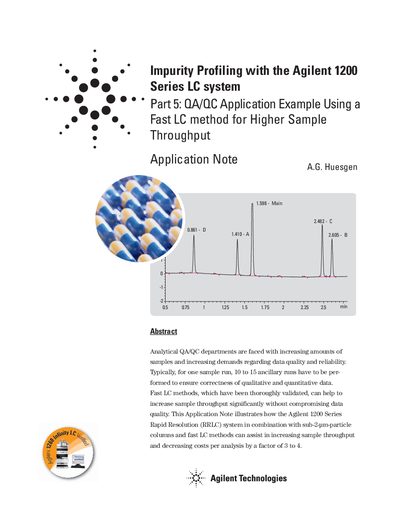
This Application Note illustrates how the Agilent 1200 Series Rapid Resolution (RRLC) system, combined with sub-2-micron particle columns and fast LC methods, can significantly increase sample throughput and decrease costs per analysis. The document focuses on transferring a validated fast analytical method to a QA/QC laboratory setting.
| Cycle time | approximately 5 minutes |
|---|---|
| Tun time | 2.8 min |
| Column dimensions | 50 x 4.6 mm |
| Particle size | 1.8-:m particles |
| Flow rate | 2.2 mL/min |
| Column temperature | 30 °C |
| Injection volume | 5 pL |
The cycle time from injection to injection is approximately 5 minutes.
Precision of areas must be < 2 % rsd and precision of retention times must be < 0.5 % rsd.
The percentage of allowed total impurity amount must be < 0.5 %.