
This Application Note describes a method for generating a small method set based on retention time windows in the pre-preparative analytical run. Using Agilent standards with known elution properties makes this an easy four-step process, which can be accomplished in less than one hour. An application example demonstrating how the resolution of the target compound can be improved is also shown.
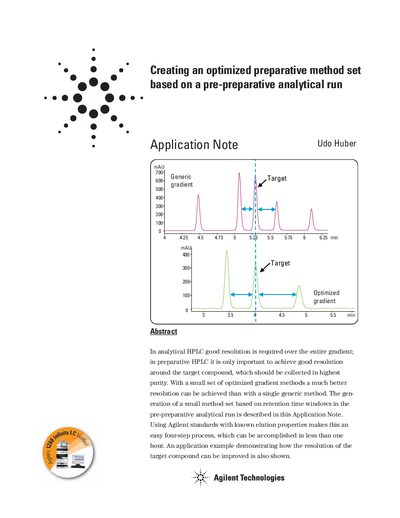
This document explains how to improve the resolution of target compounds in preparative HPLC by creating a small set of optimized gradient methods. Instead of using a single generic method, the process utilizes retention time windows from a pre-preparative analytical run to calculate specific initial and final gradient compositions for purification.
| Column | ZORBAX SB-C18, 4.6 x 50 mm, 3.5 µm |
|---|---|
| Mobile Phase A | water + 0.1 % HCOOH |
| Mobile Phase B | acetonitrile + 0.1 % HCOOH |
| Flow Rate | 1 mL/min |
| Column Temperature | 25 °C |
| UV Detector | DAD 245 nm/10 (ref. 360 nm/100) |
The process involves four easy steps: running standards, generating a diagram, calculating gradient compositions, and setting up the methods.
The slope of the gradient should not be higher than 2 — 4 %/min to ensure accurate measurements.
The example uses the Isocratic Test Sample and the Electrospray LC Demo Sample.