
This article discusses the importance of impurity isolation and purification in impurity profiling using the Agilent 1200 Series LC system, and elucidates the structures of impurities through NMR analysis. By optimizing the method and conducting loading experiments, the impurities were successfully isolated from the crude sample with high purity and recovery. Sufficient amounts of each compound were obtained through repetitive injections for further structural elucidation.
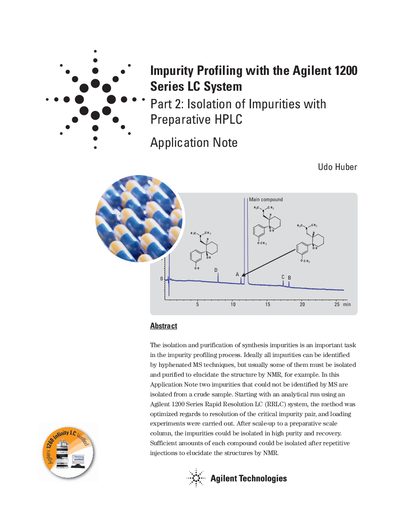
The document details a process where two specific impurities, which could not be fully characterized by mass spectrometry (MS), were isolated from a crude sample. The method began with an analytical run using the Agilent 1200 Series Rapid Resolution LC (RRLC) system to optimize resolution for a critical impurity pair.
The document describes how to isolate and purify two specific impurities from a crude sample that could not be identified by mass spectrometry.
The scale-up was performed using a ZORBAX SB-C18 column with an inner diameter of 21.2 mm and a length of 150 mm.
The method required a flow rate of approximately 21 mL/min when applied to the preparative column.