
The document describes the features of MOSPEC SRF1630CE to SRF1660CE switchmode full plastic dual Schottky barrier power rectifiers. These rectifiers utilize the Schottky barrier principle with a molybdenum barrier metal and feature state-of-the-art geometry, epitaxial construction, oxide passivation, and metal overlay contact. They are ideally suited for low voltage, high frequency rectification, or as free wheeling and polarity protection diodes.
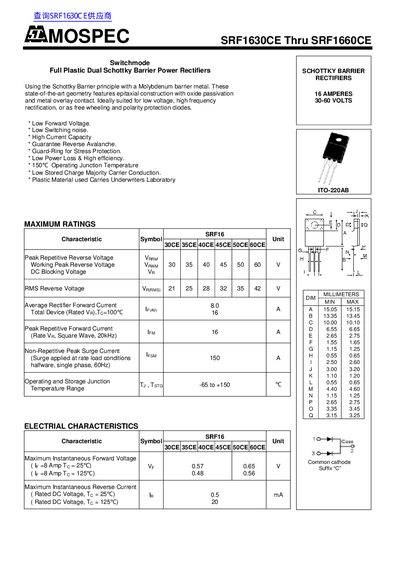
This document provides technical specifications for the MOSPEC SRF1630CE through SRF1660CE series of Schottky Barrier Power Rectifiers. These devices utilize a Molyodenum barrier metal and epitaxial construction with oxide passivation, making them ideally suited for low voltage, high frequency rectification, or as free wheeling and polarity protection diodes.
Key features include low forward voltage, low switching noise, high current capacity, and a guaranteed reverse avalanche capability. The devices operate with a junction temperature range of 65 to +150°C and are housed in plastic material carrying Underwriters Laboratory ITO-220AB certification.
| Average Rectifier Forward Current | 16 A |
|---|---|
| Peak Repetitive Forward Current | 16 A |
| Operating Junction Temperature Range | 65 to +150°C |
| Maximum Instantaneous Reverse Current | 0.5 mA |
The average rectifier forward current (Ir) is rated at 8.0 A.