
This Application Note describes the use of the Agilent 1120 Compact LC to analyze antioxidants in chewing gum.
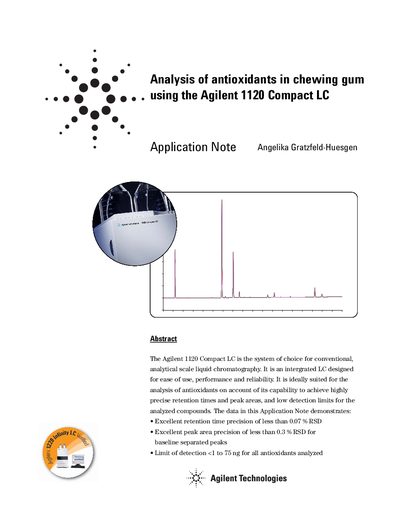
The document describes an analytical method to determine antioxidant levels, specifically Butylated Hydroxyanisole (BHA), in sugar-free chewing gum. The study utilizes the Agilent 1120 Compact LC integrated liquid chromatography system equipped with an HC-C18 column and variable wavelength detector.
Experimental results show excellent precision for retention times (less than 0.05% RSD) and peak areas (less than 0.3% RSD). The limit of detection was found to be between 1 ng and 75 ng depending on the compound. A real-life application demonstrated the detection of approximately 25 ppb of BHA in chewing gum samples.
The limit of detection was between 1 ng and 75 ng for all antioxidants analyzed.
About 25 ppb (parts per billion) of BHA could be determined in 1 g of chewing gum.
The precision of retention times for all compounds was less than 0.05% relative standard deviation (RSD).