
This document describes how to accelerate the entire method development process by using Agilent Rapid Resolution HT columns in combination with the Agilent 1200 Series Rapid Resolution LC (RRLC) system.
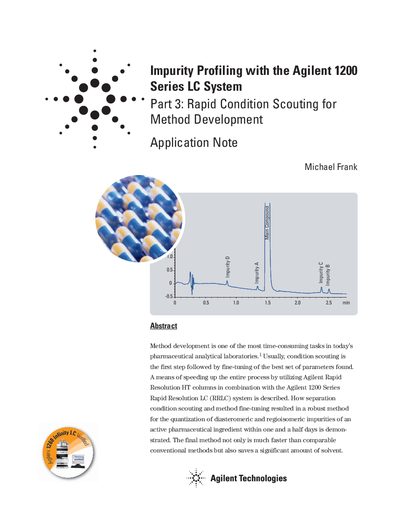
This document describes a method development process for the quantization of diastereomeric and regioisomeric impurities of an active pharmaceutical ingredient. It highlights the use of the Agilent 1200 Series Rapid Resolution LC (RRLC) system combined with Agilent ZORBAX RRHT columns to accelerate the scouting of separation conditions.
The note details an experimental setup involving the Agilent 1200 Series binary pump, autosampler, thermostat, and diode-array detector. It presents results from a broad gradient scouting phase using various stationary phases (e.g., SB CN, Extend C18, XDB C18/C8) and mobile phase modifiers (TFA, Phosphate-Buffer, NH4OH) to identify optimal conditions for separating critical impurity pairs within a short run time.
| Sample concentration | 0.7 mg/mL |
|---|---|
| Monitoring wavelength | 270 nm |
| Column temperature | 40 °C |
| Gradient start | 5 %B |
| Gradient end | 95 %B |
| Stop time | 3.50 min |
| Software | Agilent ChemStation B02.01 SR1 |
The Agilent 1200 Series Rapid Resolution LC (RRLC) system is used together with Agilent ZORBAX RRHT columns.
The objective is to provide a quick and robust method for quantization of production impurities of a pharmaceutical compound.
270 nm was chosen because all compounds of interest had a strong absorption band at this wavelength.