
This Application Note demonstrates efficient methods for conserving acetonitrile using Agilent's ZORBAX columns as a solution to the global acetonitrile shortage.
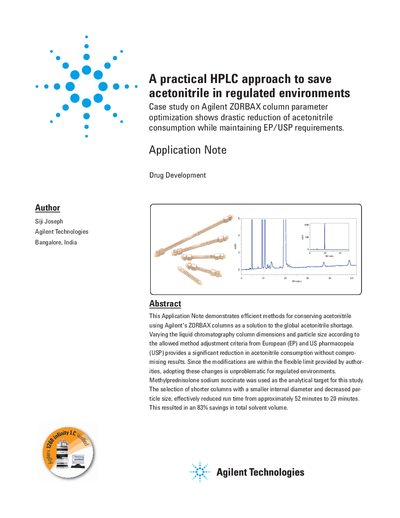
This document presents a case study on reducing acetonitrile usage in High-Performance Liquid Chromatography (HPLC) for drug development. It details how varying column parameters within the limits set by European Pharmacopeia (EP) and United States Pharmacopeia (USP) can significantly lower solvent consumption without compromising analytical results.
The study utilized methylprednisolone sodium succinate as a model compound, achieving an 83% reduction in total solvent volume. This was accomplished by shortening the column length to 100 mm, reducing particle size to 3.5 µm, and decreasing the internal diameter to 3.0 mm, all while maintaining separation performance comparable to the original method.
| Target Compound | Methylprednisolone sodium succinate |
|---|---|
| Original Column Dimensions | 250 mm x 4.6 mm, 5-um particle size |
| Optimized Column Dimensions | 100 mm length, 3.0 mm id, 3.5 um particles |
| Solvent Savings | 83% |
| Original Run Time | approximately 52 minutes |
| Optimized Run Time | approximately 20 minutes |
Column length can be adjusted by +70%, internal diameter by +25%, and particle size by -50%.
Optimizing the column to 100 mm length, 3.0 mm internal diameter, and 3.5 µm particles results in an 83% solvent savings.
The analyses were performed using the Agilent 1200 Series RRLC system.