
This Application Note compares the results of the development of an accurate and reproducible method to analyze paracetamol and related impurities according to European Pharmacopoeia (EP) and USP regulations1, using an Agilent 1120 Compact LC and a 1200 Series LC system.
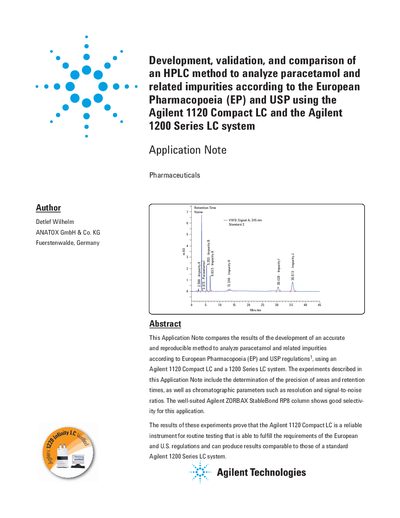
This document presents an application note comparing the performance of the Agilent 1120 Compact LC system against a standard Agilent 1200 Series LC system. The study focuses on the analysis of paracetamol and its related impurities (A, B, F, H, I, J, and K) in accordance with European Pharmacopoeia (EP) and United States Pharmacopeia (USP) regulations.
The experiments evaluated the precision of areas and retention times, as well as chromatographic parameters such as resolution and signal-to-noise ratios. The results demonstrate that the Agilent 1120 Compact LC is a reliable instrument capable of fulfilling regulatory requirements and producing results comparable to the standard 1200 Series system, making it suitable for routine quality control testing in medium to small companies.
| Mobile phase | Disodium hydrogen phosphate, sodium dihydrogen phosphate, methanol, tetrabutylammonium hydroxide |
|---|---|
| Flow rate | 1.5 mL/min |
| Column temperature | 35 °C |
| Detector wavelength | 245 nm |
| Stop time | 45 min |
The method analyzes paracetamol and impurities K, A, B, H, I, J, and F.
The relative standard deviation for retention times must be less than 0.5%.