
BAT64 is a Schottky diode from Schneider Electric. It is mainly used for low-loss, fast-recovery, meter protection, bias isolation and clamping applications. It features an integrated diffused guard ring and low forward voltage.
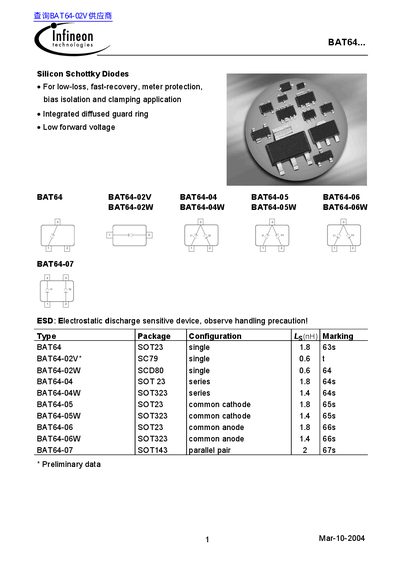
This document is a technical datasheet for the Infineon Technologies BAT64 series of Silicon Schottky Diodes. The product line includes various configurations such as single diodes (BAT64-02V/W), common cathode pairs (BAT64-05), and common anode pairs (BAT64-06), available in SOT23, SC79, SCD80, and other packages.
The datasheet provides detailed electrical characteristics including breakdown voltage, reverse current, forward voltage at various currents, diode capacitance, and reverse recovery time. It also includes graphical data for forward current versus temperature and permissible pulse load curves.
| Diode reverse voltage | 40 V |
|---|---|
| Forward current | 250 mA |
| Non-repetitive peak surge forward current | 800 (t< 10ms) |
| Junction temperature | 150 °C |
| Breakdown voltage | 40 V |
| Reverse current (Ve=30V) | 2 uA |
These diodes are designed for low-loss, fast-recovery uses such as meter protection, bias isolation, and clamping applications.
The maximum forward current rating is 250 mA.
The maximum junction temperature is 150 °C.