
Agilent SuperNova Novel Techniques in Determining Absolute Structure of Light-atom Containing Molecules Application Note

This application note introduces novel statistical methods for determining the absolute structure of light-atom organic molecules. All of these methods require precise experimental determination of very small differences in the intensities of related reflections, which is facilitated by Agilent’s micro-focus SuperNova X-ray diffractometer.
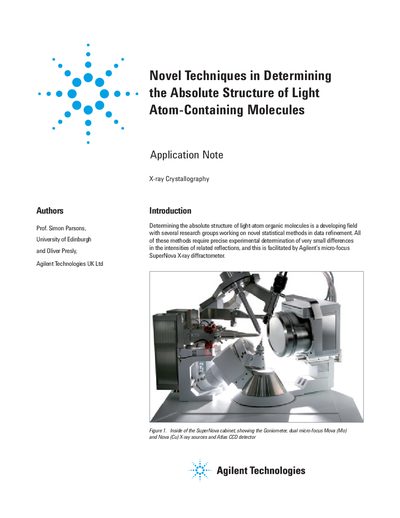

Agilent SuperNova Novel Techniques in Determining Absolute Structure of Light-atom Containing Molecules Application Note - cover page
Brand
Agilent
Document type
Application Note
Language
English
Pages
4
File format
PDF
File size
336 KB
Published
11 June, 2012
Updated
29 September, 2023
MD5 checksum
043F76BBFB4D1B1491D2575339F3D288

About this manual

Determining the absolute structure of light-atom organic molecules is challenging due to small differences in reflection intensities. This document introduces novel statistical methods, specifically Quotient Restraints and Hooft parameters, which provide more conclusive results than traditional Flack parameter analysis for samples containing elements lighter than sulfur.

What's inside

  • Introduction
  • Theory
  • Experimental
  • Results
  • Conclusions

Frequently asked questions

What is the minimum error value required for a publication-quality absolute configuration assignment using the Flack parameter?

The error (esd) must be less than 0.1.

How many reflections should be selected to improve the quality of the absolute configuration refinement using Quotient restraints?

The 20 reflections with the most influence should be selected.

What redundancy factors are recommended for obtaining the best results in light atom absolute configuration data?

Redundancy factors of 10-15 give the best results.

Download PDF (336 KB)

More Agilent Manuals


View all Agilent manuals →