
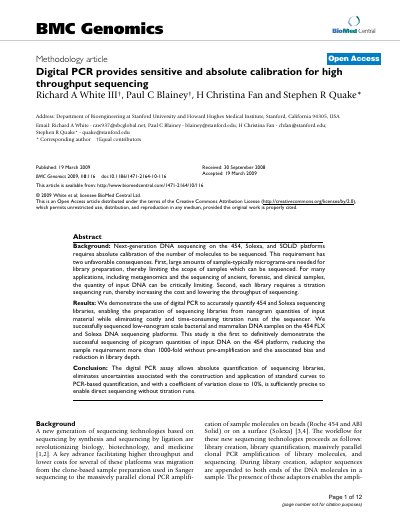
This BMC Genomics methodology article by White, Blainey, Fan and Quake was published on 19 March 2009. It describes digital PCR as a method for absolute quantification of sequencing libraries and reports sequencing of low-nanogram bacterial and mammalian DNA samples on the 454 FLX and Solexa platforms.
The article states that digital PCR allows absolute quantification, eliminates uncertainties associated with standard curves for PCR-based quantification, and has a coefficient of variation close to 10%. It also includes a comparison table of current sequencing library quantification methods, including Nanodrop, capillary gel electrophoresis, Ribogreen, real-time PCR and digital PCR.
The study mentions the 454 FLX and Solexa DNA sequencing platforms.
It counts individual template molecules by counting positive PCR reactions at the reaction endpoint.
The assay has a coefficient of variation close to 10%.
It eliminates uncertainties associated with the construction and application of standard curves to PCR-based quantification.