
This Application Note describes the development of an immunoprecipitation method in combination with microfluidic on-chip analysis on the Agilent 2100 Bioanalyzer for sensitive, selective and quantitative detection of endogenous β-galactosidase in crude E. coli lysates. The effects of antibody selection and the importance of preclearing steps for sensitive and specific detection of the target protein are discussed. Quantification of β-galactosidase was achieved via an external calibration curve based on various spiking levels of pure β-galactosidase into E. coli lysate. Results proved the described approach to be quantitative over orders of magnitudes and highly reproducible.
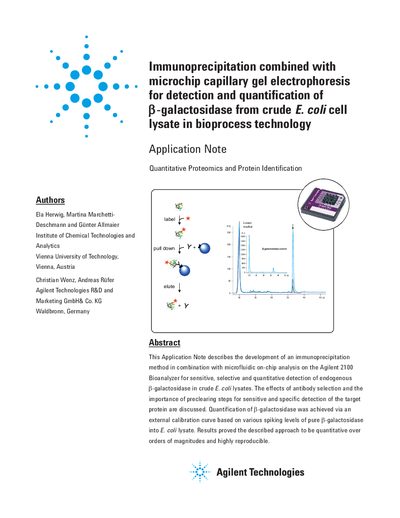
This document details a strategy for protein identification and quantification that combines immunoprecipitation (IP) with automated SDS-Microchip Capillary Gel Electrophoresis (MCGE) on the Agilent 2100 Bioanalyzer. The primary goal is the sensitive and selective detection of endogenous B-galactosidase in crude E. coli cell lysates, which is crucial for bioprocess technology and genetic engineering.
The workflow involves sample preparation, protein labeling using the High Sensitivity Protein 250 Kit, and a specific immunoprecipitation protocol utilizing Protein G coated magnetic beads. Key steps include sample preclearing to reduce background noise, antibody incubation, immunocomplex capturing, and elution. Quantification is achieved by creating an external calibration curve based on spiking pure B-galactosidase into a deficient strain lysate.
The preclearing step eliminates nonspecific protein binding to the beads and significantly reduces unwanted background signals.
The culture is centrifuged at 3,750 x g for 15 minutes at 4 °C.