
This Application Note introduces the concept of peak capacity and investigates the effects of gradient parameters such as flow rate, gradient time, column length and gradient slope on peak capacity. The results show that flow rate and gradient time have a significant effect on peak capacity. The effects of column length and gradient slope on peak capacity are relatively small.
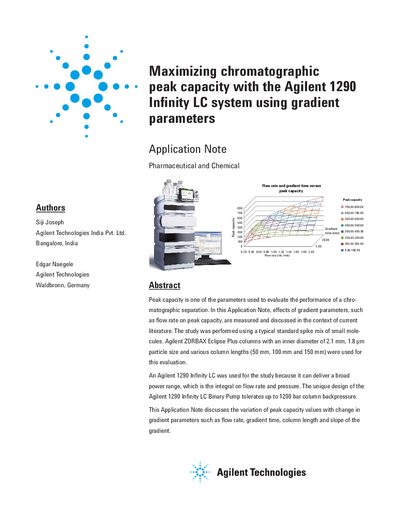
This document is an application note discussing the effects of gradient parameters, such as flow rate and gradient time, on chromatographic peak capacity. The study was performed using a standard spike mix of small molecules and Agilent ZORBAX Eclipse Plus columns with various lengths (50 mm, 100 mm, and 150 mm).
The Agilent 1290 Infinity LC system was selected for the study because it can deliver a broad power range, tolerating up to 1200 bar column backpressure. The note details the experimental setup, including the instrument configuration, chemicals used, and specific LC parameters. It presents results showing that peak capacity increases dramatically with higher flow rates and longer gradient times, providing practical guidance for method development to separate complex samples.
| Column type | Agilent ZORBAX Eclipse Plus C18 |
|---|---|
| Column lengths tested | 50 mm, 100 mm, 150 mm |
| Maximum backpressure | 1200 bar |
| Detector sampling rate | 80 Hz |
| Mobile phase A | 0.1% formic acid in water |
| Mobile phase B | 100% acetonitrile |
| Column temperature | 50 °C |
| Injection volume | 2 µL |
The Agilent 1290 Infinity LC Binary Pump tolerates up to 1200 bar column backpressure.
Peak capacity values are smaller for lower flow rates and increase dramatically with higher flow rates because peak widths decrease with increasing flow rates.