
This document describes the use of the Agilent 1260 Bio-inert Quaternary LC system for sensitive and rapid LC methods to characterize the therapeutic protein, P128. Optimized peptide maps were constructed using sub-2-µm column technology to decrease analysis speed for this protein. Size exclusion chromatography (SEC) and ion exchange chromatography (IEX) were performed using the new Agilent Bio-HPLC columns to detect potential impurities or isoforms of the protein preparation. The bio-inertness and corrosion resistance of the instrument coupled with the simple and reproducible methods make this solution suitable for routine use in QA/QC labs.
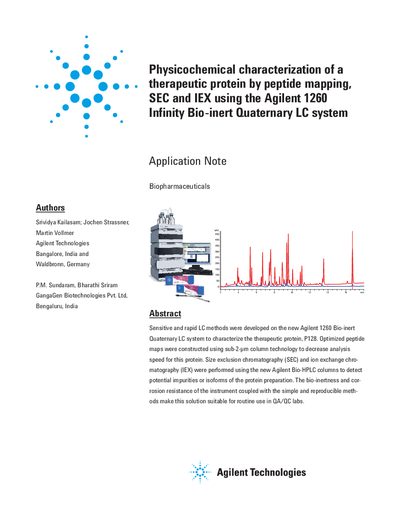
This document describes the development of sensitive and rapid liquid chromatography (LC) methods for characterizing the therapeutic protein P128. The study utilizes the Agilent 1260 Infinity Bio-inert Quaternary LC system, which features a completely bioinert flow path free of metal components to prevent adsorption of hydrophobic peptides and proteins.
The application note details the use of sub-2-µm column technology to optimize peptide maps and reduce analysis time while maintaining resolution. It also presents results from Size Exclusion Chromatography (SEC) and Ion Exchange Chromatography (IEX) using specific Agilent Bio-HPLC columns to detect potential impurities or isoforms, demonstrating the system's suitability for routine use in QA/QC laboratories.
| Maximum pressure | 600 bar |
|---|---|
| Injection volume (Peptide mapping) | 2 µL |
| Flow rate (Peptide mapping) | 0.2 mL/min |
| Column 1 (Peptide mapping) | Agilent ZORBAX Eclipse Plus C18 3.0 mm x 100 mm, 1.8 µm |
| Column 2 (Peptide mapping) | Agilent Poroshell 120 EC-C18 3.0 mm x 150 mm, 2.7 µm |
| Column 1 (SEC) | Agilent Bio-SEC-3, 3 µm, 300 Å, 7.8 mm x 300 mm |
| Column 2 (SEC) | Agilent Bio-SEC-5, 5 µm, 300 Å, 7.8 mm x 300 mm |
| Column 1 (IEX) | Agilent Bio MAb NP 5, PK, 4.6 mm x 250 mm, 5 µm |
| Column 2 (IEX) | Agilent Bio MAb NP 10, PK, 4.6 mm x 250 mm, 10 µm |
The system has a maximum pressure of 600 bar.
The injection volume used for peptide mapping is 2 µL.
The SEC experiment used Agilent Bio-SEC-3 (3 µm) and Agilent Bio-SEC-5 (5 µm) columns.