
Negative Thermal Expansion in Metal Cyanides using Variable Temperature Powder Diffraction Application Note

This article introduces a method for studying the negative thermal expansion of metal cyanides using variable temperature powder diffraction.
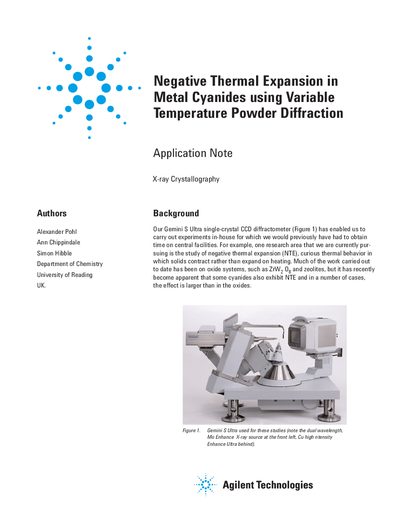

Negative Thermal Expansion in Metal Cyanides using Variable Temperature Powder Diffraction Application Note - cover page
Brand
Agilent
Document type
Application Note
Language
English
Pages
4
File format
PDF
File size
585 KB
Published
11 June, 2012
Updated
30 September, 2023
MD5 checksum
8FB16C962D7DB5F52A397321570FB1BD

About this manual

The document details experiments conducted with an Agilent Gemini S Ultra single-crystal CCD diffractometer to study negative thermal expansion (NTE). While the instrument is primarily a single-crystal device, its powder diffraction capability was utilized to analyze metal cyanide compounds that could not be prepared as single crystals. The study focuses on HT-CuCN, AgCN, and AuCN, which contain infinite -(M-C=N)- chains.

What's inside

  • Background
  • Experimental
  • Results
  • Negative Thermal Expansion
  • Metal Cyanides

Frequently asked questions

What temperature range does the Helijet cooling device cover?

The Helijet open flow helium cooling device operates in the 10-100 K range.

What temperature range does the Cryojet HT cooling device cover?

The Oxford Instruments Cryojet HT operates in the 90-490 K range.

How long is each diffraction image collected?

Each image is collected over 240 seconds.

Download PDF (585 KB)

More Agilent Manuals


View all Agilent manuals →