
This paper introduces a new type of X-ray source for the characterization of the crystal structures of derivatized resorcarenes, which has both Mo and Cu X-ray radiation sources, and experimentally verifies its effectiveness in the characterization of the crystal structures of derivatized resorcarenes.
This document details a study conducted by researchers at Ruhr-University Bochum using an Agilent Gemini R diffractometer to analyze two derivatised resorcarene molecules. The research highlights the limitations of using standard Molybdenum (Mo) radiation for weakly diffracting, large molecules and the critical role of switching to Copper (Cu) radiation to obtain high-quality data.
The study successfully determined the crystal structure of a bromo-resorcarene using Mo radiation. However, for a second molecule with four pendant amino acid arms, the weak diffraction power of Mo radiation was insufficient. By switching to Cu radiation, which offered up to 8x diffracting power, the researchers were able to solve the structure and unequivocally assign the stereochemistry at the molecule's four chiral centers.
| Data collection time (bromo-resorcarene) | 22 hours |
|---|---|
| Data collection time (pendant resorcarene) | 38 hours |
| Temperature | 100K |
| Final R1 (bromo-resorcarene) | 6.7% |
| Final R1 (pendant resorcarene) | 11.2% |
| Flack parameter (pendant resorcarene) | 0.08(5) |
Cu radiation was essential because the crystals were small and weakly diffracting, and the increased X-ray intensity and diffracting power allowed the structure to be solved.
The use of Cu radiation allowed the stereochemistry of the four chiral centers to be unequivocally assigned as the S configuration.
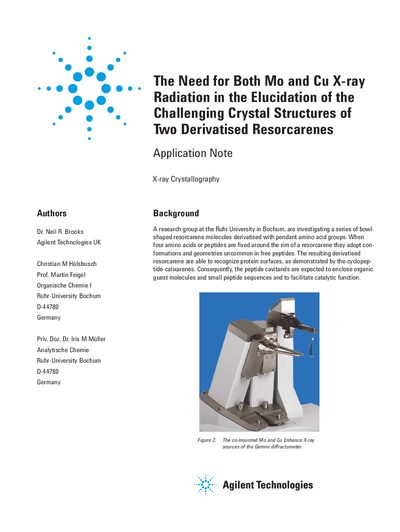
The wavelength changeover is achieved via a software switch and takes less than 3 minutes before Cu data collection starts.