
This document describes the use of Xcalibur PX Ultra to collect highly redundant data from cubic insulin at York Structural Biology Laboratory, demonstrating protein structure phasing using the sulfur anomalous signal. The document provides details on the data collection, indexing, integration, and refinement processes.
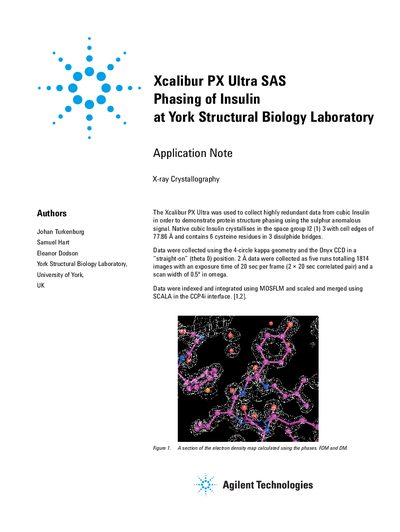
This document describes an experiment conducted at the York Structural Biology Laboratory to demonstrate protein structure phasing using the sulphur anomalous signal. The study utilized native cubic Insulin, which crystallizes in the space group I2 (1) 3 with cell edges of 77.86 A and contains 6 cysteine residues in 3 disulphide bridges.
Data collection was performed using the Agilent Xcalibur PX Ultra system equipped with a 4-circle kappa geometry and an Onyx CCD detector. Two data sets were collected: one at 2 A resolution and another at 1.5 A resolution. The results showed that all six sulphur positions were readily located, and the resulting electron density map was of very high quality.
| Detector distance | 80 mm (Range 60-150 mm) |
|---|---|
| Optics type | Enhance Ultra (incorporating multi-layer optics) |
| Temperature | 120 Kelvin |
| Power | 2.2 kW (max possible 3 kW) |
The maximum possible power for the system is 3 kW.