
This document introduces how to quickly identify o-rings, seals and gaskets using the handheld Agilent 4100 ExoScan FTIR analyzer.
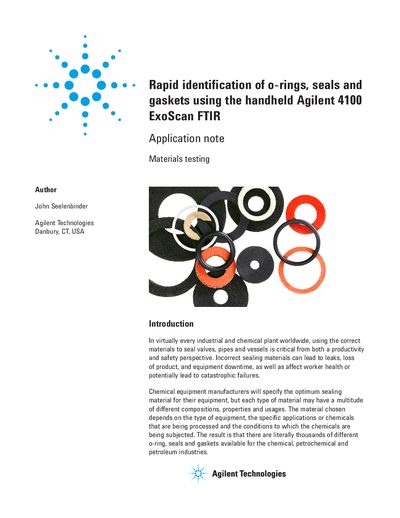
This document details the application of the Agilent 4100 ExoScan FTIR system for identifying sealing materials in industrial and chemical plants. It highlights the system's ability to analyze difficult-to-test carbon black-filled elastomers using a spherical germanium ATR sample interface, which minimizes light scattering and baseline shifts compared to other methods like diamond ATR or Near-IR.
| Interferogram co-addition time | 20 second |
|---|---|
| Battery life | 132 minutes |
No, the method is non-destructive; the sample is measured without cutting or deforming the surface.
The handheld analyzer is used to rapidly identify o-rings, seals, and gaskets made of organic-based sealing materials.
The spectra were recorded using a 20 second interferogram co-addition.
The system records spectra at an 8 cm-1 resolution.