
US6K2 is a 4V Drive Nch+Nch MOSFET that features high-speed switching and low On-resistance.
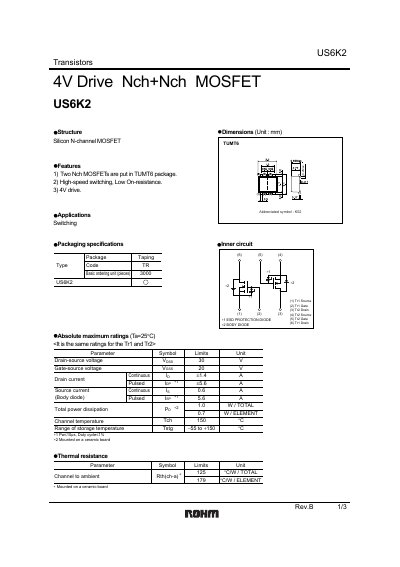
The US6K2 is a dual N‑channel MOSFET packaged in a TUMT6 case, offering high‑speed switching, low on‑resistance, and a 4 V gate drive. It is intended for switching applications and can be mounted on a ceramic board.
Key specifications include a 30 V drain‑source rating, 20 V gate‑source rating, continuous drain current of 41.4 A, and a total power dissipation of 1.0 W. The device is supplied in a tape‑and‑reel format with a basic ordering unit of 3000 pieces.
| Drain‑source voltage (VDS) | 30 V |
|---|---|
| Gate‑source voltage (VGS) | 20 V |
| Continuous drain current (ID) | 41.4 A |
| Pulsed drain current (ID,pulse) | 45.6 A |
| Continuous source current (IS) | 0.6 A |
| Body‑diode pulsed current | 5.6 A |
| Total power dissipation | 1.0 W (total) |
| Power dissipation per element | 0.7 W |
| Maximum junction temperature | 150 °C |
| Storage temperature range | -55 °C to +150 °C |
| Thermal resistance (junction‑to‑ambient) | 125 °C/W (total) |
The US6K2 can withstand up to 30 V drain‑source voltage.
It is rated for a continuous drain current of 41.4 A.
The device is supplied in a TUMT6 dual‑MOSFET package.
The recommended storage temperature range is –55 °C to +150 °C.