
This is a PC terminal block PTDA 1,5/ 4-3,5 produced by PHOENIX CONTACT. The rated current is 13.5A, the rated voltage is 200V, the pitch is 3.5mm, the number of positions is 4, the connection type is spring cage conn., the assembly is soldering, the conductor/PCB connection direction is 45°, and the color is green.
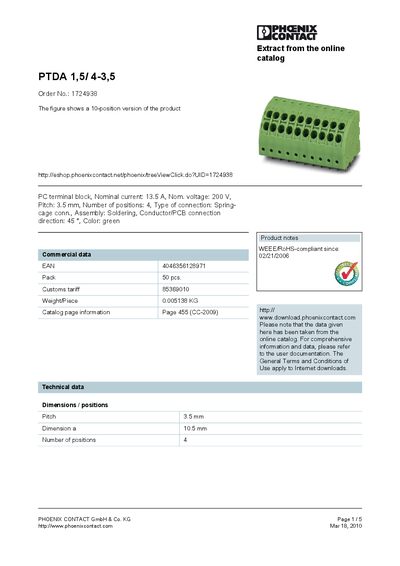
The PTDA 1.5/4-3.5 is a 4‑position spring‑cage terminal block with a 3.5 mm pitch, designed for soldering assembly. It supports a nominal current of 13.5 A and a nominal voltage of 200 V, and is supplied in green‑colored housing.
The datasheet provides detailed dimensions, pin spacing, rated surge and working voltages, conductor cross‑section limits, and certification information (CUL, UL). Additional diagrams show drilling plans, derating curves, and mechanical drawings. The product complies with RoHS since February 2006 and is packaged in packs of 50 pieces.
| Nominal current | 13.5 A |
|---|---|
| Nominal voltage | 200 V |
| Pitch | 3.5 mm |
| Number of positions | 4 |
| Weight per piece | 0.005138 kg |
| EAN | 4046356128971 |
The nominal current is 13.5 A.
The pitch is 3.5 mm.
It has 4 positions.
Each piece weighs 0.005138 kg.