
This document describes the features and characteristics of the 301U(R) Series Standard Recovery Diodes, including wide current range, high voltage ratings, and high surge current capabilities. The product is suitable for converters, power supplies, machine tool controls, high power drives, and medium traction applications.
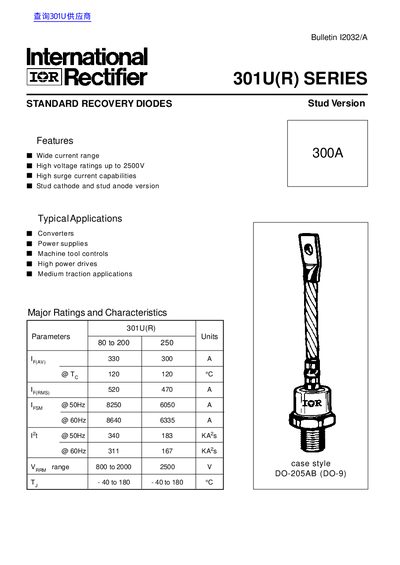
This handbook describes the 301U(R) Series standard recovery diodes, covering their electrical and thermal characteristics, mechanical dimensions, and ordering options. It includes detailed tables of voltage ratings, forward current capabilities, and thermal resistance values.
Typical applications such as converters, power supplies, machine‑tool controls and high‑power drives are listed, along with the physical case style and mounting guidelines for designers and engineers.
| Maximum voltage rating | 2500 V |
|---|---|
| Maximum average forward current | 330 A |
| Junction operating temperature range | -40 to 180 °C |
| Thermal resistance, junction to case | 0.14 K/W |
| Case style | DO-205AB (DO-9) |
The diodes are rated for up to 2500 V.
They use a DO‑205AB (DO‑9) case style.
The maximum average forward current is 330 A.