
The KPT/KPSE connector series are ITT Cannon manufactured miniature circular connectors made to MIL-C-26482 standard, with three point bayonet coupling and five keyway polarization. They offer general purpose solder connectors and high performance crimp connectors. The broad product range provides the most complete family of connectors conform to MIL-C-26482, NFC 93422 HE 301 model, VG 95328 and LN 29500 specifications. The versatility of these connectors has been proven by their usage in general as well as in high performance environmental applications. In addition to the basic series presented in this catalogue, connectors for special applications are available. They include corrosion resistant types, filter connectors for electromagnetic compatability and non-outgasing, radiation resistant versions. All connectors conform to the above mentioned specifications.
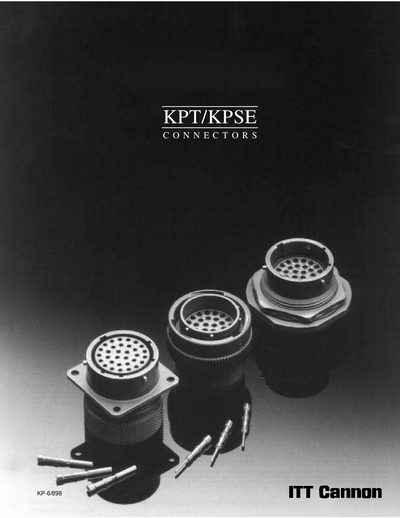
The KPT and KPSE series are miniature circular connectors manufactured by ITT Cannon to MIL‑C‑26482 and related specifications. They are offered in solder‑termination (KPT) and high‑performance crimp (KPSE) versions, with a variety of shell styles, sizes, and service classes for general‑purpose and demanding environmental applications.
The document provides detailed mechanical and electrical data, ordering codes, cross‑reference lists, and product safety guidelines to assist designers and technicians in selecting the appropriate connector for their applications.
| Operating voltage | 50 V |
|---|---|
| Shell sizes | 8, 10, 12, 14, 16, 18, 20, 22, 24 |
| Number of contacts | 8 thru 24 |
| Test pressure | 0.2 bar overpressure |
| Test duration | 48 h |
| Operating temperature range | -55 °C to 125 °C |
| Minimum mating cycles | 500 cycles |
They are manufactured according to MIL‑C‑26482 and are also compatible with NFC 93422 HE 301, VG 95328, and LN 29500 specifications.
Yes, the KPSE series is described as high‑performance crimp contact connectors designed for demanding electronic industry requirements.
The connectors are rated for a minimum of 500 mating cycles.
They are tested to 0.2 bar overpressure for 48 hours.