
TSUS4300 is an infrared emitting diode produced by Vishay Semiconductors. It is made of standard GaAs on GaAs technology and has a transparent blue plastic package. The device has high radiant power and radiant intensity, low forward voltage, suitable for DC and high pulse current operation, standard T-1(∅ 3 mm) package, ±16° half power angle, 950nm peak wavelength, high reliability, good spectral matching to Si photodetectors, lead-free component, in accordance with RoHS 2002/95/EC and WEEE 2002/96/EC standards. It is used in small packages and low-cost requirements of infrared remote control systems in combination with silicon photo detectors, infrared source in reflective sensors, table end detection. It has excellent matching with photo-transistor TEFT 4300.
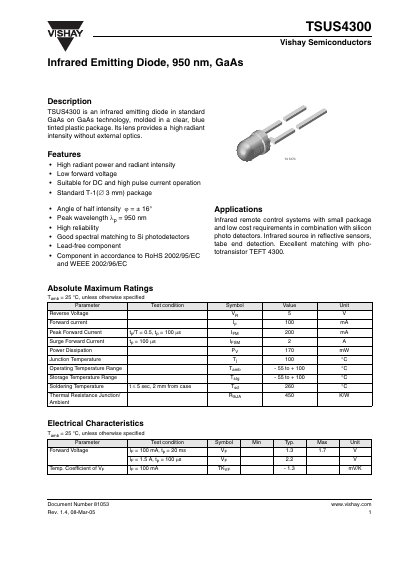
The TSUS4300 is a 950 nm infrared emitting diode fabricated with standard GaAs technology and housed in a clear, bluetinted plastic T‑1 package (3 mm diameter). Its lens delivers high radiant intensity without external optics, making it suitable for remote‑control systems, reflective sensors, and end‑point detection.
The document lists electrical ratings such as a forward voltage of about 1.3 V, a continuous forward current of 200 mA (2 A surge), and a maximum junction temperature of 100 °C. Optical data include a peak wavelength of 950 nm, radiant power of 20 mW at 100 mA, and a half‑intensity angle of ±16°. The device is lead‑free and complies with RoHS and WEEE directives.
| Peak wavelength | 950 nm |
|---|---|
| Forward voltage (typical) | 1.3 V |
| Maximum continuous forward current | 200 mA |
| Maximum junction temperature | 100 °C |
The TSUS4300 emits at a peak wavelength of 950 nm.
The diode is rated for a continuous forward current of 200 mA, with a 2 A surge capability.
Yes, the component is lead‑free and complies with RoHS 2002/95/EC.
Soldering should be limited to 5 seconds with the tip kept at least 2 mm from the case.