
CNY17F is an optocoupler consisting of a gallium arsenide infrared emitting diode optically coupled to a silicon planar phototransistor detector in a plastic plug-in DIP-6 package. It has features such as isolation test voltage, no base terminal connection for improved common mode interface immunity, and long term stability.
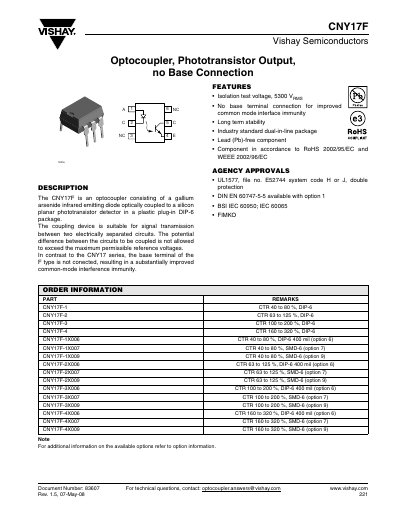
The CNY17F is an optocoupler that combines a gallium‑arsenide infrared emitting diode with a silicon planar phototransistor in a plastic DIP‑6 package. It is designed for signal transmission between two electrically isolated circuits and features a no‑base‑connection design for improved common‑mode immunity.
The document lists absolute maximum ratings, typical electrical characteristics, switching performance, and detailed package dimensions. It also includes ordering codes, option information for different lead configurations, and compliance statements such as RoHS and ozone‑depleting substance policies.
| Isolation test voltage | 5300 V RMS |
|---|---|
| Forward voltage (typical) | 1.65 V |
| Collector‑emitter breakdown voltage | 70 V |
| Current transfer ratio (CNY17F‑3) | 100 % to 200 % |
| Reverse voltage (input) | 6.0 V |
| Power dissipation (max) | 100 mW |
| Input capacitance | 25 pF |
| Thermal resistance (junction‑to‑ambient) | 750 K/W |
The isolation test voltage is 5300 V RMS.
The device can tolerate a reverse voltage of up to 6.0 V.
CNY17F‑3 has a current transfer ratio ranging from 100 % to 200 %.