
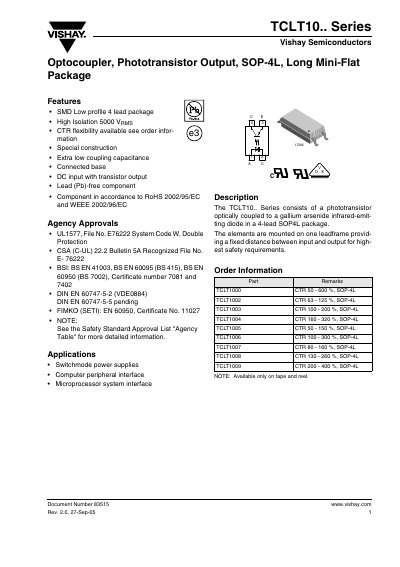
The TCLT10.. Series optocouplers integrate a gallium‑arsenide infrared LED with a phototransistor in a 4‑lead SOP‑4L package. They are intended for use in switch‑mode power supplies, computer peripheral interfaces, and microprocessor system interfaces.
Key features include a high isolation voltage of 5000 VRMS, low coupling capacitance, and a wide CTR range (50‑600 %). The device operates from –40 °C to +100 °C, with typical forward voltage around 1.6 V and power dissipation up to 100 mW. Switching times are in the low‑microsecond range, making the series suitable for high‑speed isolation applications.
| Isolation voltage | 5000 VRMS |
|---|---|
| Current Transfer Ratio (CTR) | 50‑600 % |
| Forward voltage (typical) | 1.6 V |
| Power dissipation | 100 mW |
| Junction temperature | 125 °C |
| Operating temperature range | -40 °C to +100 °C |
| Storage temperature range | -40 °C to +100 °C |
| Package | SOP‑4L (4‑lead) |
The device is rated for an isolation voltage of 5000 VRMS.
The TCLT1000 offers a current transfer ratio between 50 % and 600 %.
It can operate from –40 °C up to +100 °C.
The optocouplers are supplied in a 4‑lead SOP‑4L package.