
The MAX9155 is a low-voltage differential signaling (LVDS) repeater that accepts a single LVDS input and duplicates the signal at a single LVDS output. Its low-jitter, low-noise performance makes it ideal for buffering LVDS signals sent over long distances or noisy environments, such as cables and backplanes. The MAX9155's tiny size makes it especially suitable for minimizing stub lengths in multidrop backplane applications. The SC70 package (half the size of a SOT23) allows the MAX9155 to be placed close to the connector, thereby minimizing stub lengths and reflections on the bus. The point-to-point connection between the MAX9155 output and the destination IC, such as an FPGA or ASIC, allows the destination IC to be located at greater distances from the bus connector. Ultra-low, 23psp-p added deterministic jitter and 0.6psRMS added random jitter ensure reliable communication in high-speed links that are highly sensitive to timing errors, especially those incorporating clock-and-data recovery, PLLs, serializers, or deserializers. The MAX9155's switching performance guarantees a 200Mbps data rate, but minimizes radiated noise by guaranteeing 0.5ns minimum output transition time. The MAX9155 has fail-safe circuitry that sets the output high for undriven open, short, or terminated inputs. The MAX9155 operates from a single +3.3V supply and consumes only 10mA over a -40°C to +85°C temperature range. Refer to the MAX9129 data sheet for a quad bus LVDs.
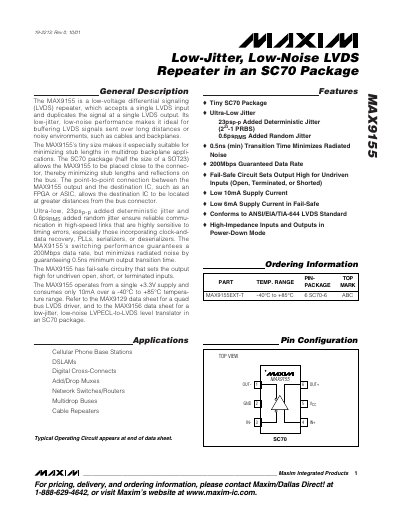
The MAX9155 LVDS repeater accepts a single LVDS input and reproduces the signal at a single LVDS output. Its tiny SC70 package (half the size of a SOT23) allows placement close to connectors, minimizing stub lengths and reflections. The device provides ultra‑low 23 ps p‑p deterministic jitter, 0.6 ps RMS random jitter, and a guaranteed 200 Mbps data rate with a minimum 0.5 ns output transition time.
It operates from a single +3.3 V supply, drawing only about 10 mA, and includes a fail‑safe circuit that forces the output high when inputs are undriven, open, shorted, or terminated. Typical applications include cellular base stations, DSLAMs, network switches, multidrop backplane buses, and cable repeaters.
| Maximum Data Rate | 200 Mbps |
|---|---|
| Minimum Output Transition Time | 0.5 ns |
| Deterministic Jitter | 23 ps p‑p |
| Random Jitter (RMS) | 0.6 ps |
| Supply Voltage | +3.3 V |
| Supply Current | 10 mA |
| Package | SC70 (6‑lead) |
The MAX9155 supports a maximum data rate of 200 Mbps.
It operates from a single +3.3 V supply and draws about 10 mA.
The device is supplied in an SC70 surface‑mount package, which is about half the size of a SOT23.