
This document provides information about the features and characteristics of Intel's 8XC152JA, JB, JC, JD Universal Communication Controller, including differentiation from other brands, product details, and technical specifications.
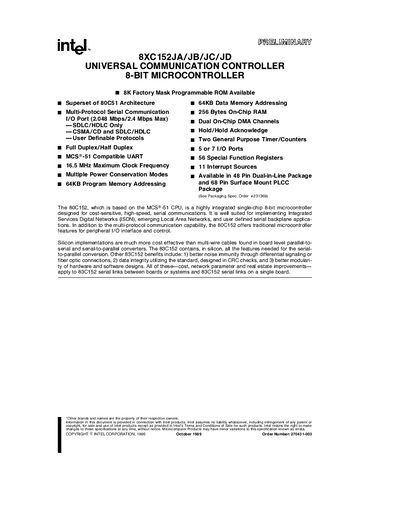
The 8XC152 series is a highly integrated 8‑bit microcontroller based on the MCS‑51 architecture, offering a superset of features such as multi‑protocol serial communication, dual DMA channels, and up to 64 KB of program and data memory. It is available in 48‑pin DIP and 68‑pin PLCC packages and supports both internal and external oscillators.
The document provides detailed pin descriptions, electrical characteristics, timing diagrams, and design notes for implementing the device in cost‑sensitive, high‑speed serial communication applications.
| Maximum Clock Frequency | 16.5 MHz |
|---|---|
| Program Memory | 64 KB |
| Data Memory | 64 KB |
| On‑Chip RAM | 256 Bytes |
| I/O Ports | 5 or 7 |
| Interrupt Sources | 11 |
| Power Dissipation | 1.0 W |
In Idle Mode the CPU sleeps while most on‑chip peripherals stay active; DMA channels stop and the mode can be exited by any enabled interrupt or a hardware reset.
Power‑Down Mode stops the oscillator and all on‑chip functions except the on‑chip RAM, and it can only be terminated by a hardware reset.