
The Intel® LXT9785 and Intel® LXT9785E are 8-port Fast Ethernet PHY Transceivers supporting IEEE 802.3 physical layer applications at 10 Mbps and 100 Mbps. These devices provide Serial/Source Synchronous Serial Media Independent Interfaces (SMII/SS-SMII) and Reduced Media Independent Interface (RMII) for switching and other independent port applications. The LXT9785 and LXT9785E are identical except for the IP telephony features included in the LXT9785E transceiver. The LXT9785E is an enhanced version of the LXT9785 that detects Data Terminal Equipment (DTE) requiring power from the switch over a CAT5 cable. The system uses the information collected by the LXT97985E to apply power if the DTE at the far end requires power over the cable, such as an IP telephone. Each network port can provide a twisted-pair (TP) or Low-Voltage Positive Emitter Coupled Logic (LVPECL) interface. The twisted-pair interface supports 10 Mbps and 100 Mbps (10BASE-T and 100BASE-TX) Ethernet over twisted-pair. The LVPECL interface supports 100 Mbps (100BASE-FX) Ethernet over fiber-optic media. The LXT9785/LXT9785E provides three discrete LED driver outputs for each port. The devices support both half-duplex and full-duplex operation at 10 Mbps and 100 Mbps and require only a single 2.5 V power supply.
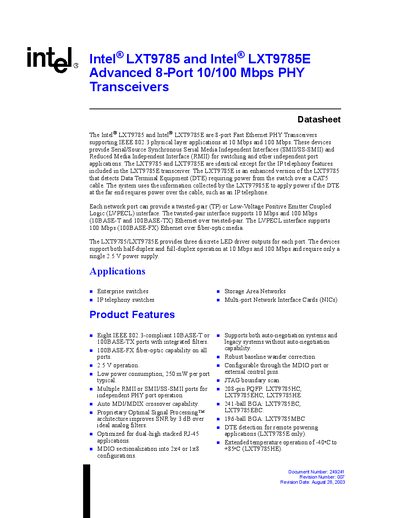
The LXT9785/LXT9785E family provides eight IEEE 802.3‑compliant Ethernet ports that can operate over twisted‑pair (10BASE‑T/100BASE‑TX) or fiber‑optic (100BASE‑FX). Each port supports auto MDI/MDIX crossover and can deliver up to 250 mW typical power consumption per port while running from a single 2.5 V supply.
The LXT9785E variant adds IP‑telephony capabilities, detecting DTE devices that require power over the cable (CATS) and enabling remote power delivery. The devices are intended for enterprise and IP‑telephony switches, offering configurable interfaces via MDIO or external pins and supporting both half‑ and full‑duplex operation.
| Number of ports | 8 |
|---|---|
| Fiber‑optic capability | 100BASE‑FX on all ports |
| Supply voltage | 2.5 V |
| Power consumption per port | 250 mW typical |
| Auto MDI/MDIX | Supported |
The LXT9785E is an enhanced version that includes IP‑telephony features and can detect Data Terminal Equipment (DTE) for remote powering, which the LXT9785 does not have.
They operate from a single 2.5 V power supply.
Each device provides eight Ethernet ports.