
This document introduces Intel's Word-Wide FlashFile™ memory family, which provides high-density, low-cost, non-volatile, read/write storage solutions for a wide range of applications. The memory family has a symmetrically-blocked architecture, flexible voltage, and extended cycling life, which makes it suitable for resident flash arrays, SIMMs, and memory cards. Enhanced suspend capabilities can improve system performance.
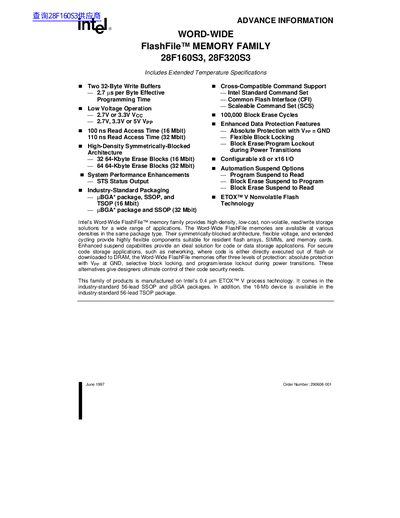
The Intel Word‑Wide FlashFile™ memory family provides high‑density, low‑cost, non‑volatile storage for a variety of applications. The 28F160S3 (16 Mbit) and 28F320S3 (32 Mbit) devices feature symmetrically‑blocked architecture, low‑voltage operation, and enhanced suspend capabilities, making them suitable for resident flash arrays, SIMMs, and memory cards.
The datasheet includes sections on product overview, pinout and pin description, bus operation, command definitions, design considerations, and detailed electrical specifications such as read access times, supply voltages, and block erase cycles. Appendices list device nomenclature, ordering information, and additional reference documents.
| Package Types | 56‑lead SSOP, 56‑lead TSOP, uBGA, HBGA |
|---|---|
| Read Access Time | 100 ns (3.3 V), 120 ns (2.7 V‑3.6 V) |
| Operating Voltage (Vcc) | 2.7 V‑3.6 V |
| Block Erase Cycles | 100,000 cycles per 64‑Kbyte block |
| Write Buffers | Two 32‑Byte write buffers |
The 28F160S3 operates at 2.7 V‑3.6 V Vcc, with Vpp options of 2.7 V, 3.3 V, or tied to Vcc for low‑voltage operation.
Each 64‑Kbyte block can be erased up to 100,000 times.
The 28F160S3 is offered in 56‑lead TSOP, 56‑lead SSOP, and uBGA packages.