
MAX7030 is a radio frequency transceiver manufactured by Texas Instruments. It has a 16-bit fractional N phase-locked loop (PLL), works at 315MHz, 345MHz or 433.92MHz, supports ASK/OOK modulation with bandwidth up to 33kbps (Manchester encoded) or 66kbps (NRZ encoded). The device has a typical output power of +10dBm into a 50Ω load and exhibits a typical sensitivity of -114dBm. MAX7030 has separate transmit and receive pins (PAOUT and LNAIN) and provides an internal RF switch that can be used to connect the transmit and receive pins to a common antenna. MAX7030 transmit frequency is generated by a 16-bit fractional-N PLL, while the receiver's local oscillator (LO) is generated by an integer-N PLL. This hybrid architecture eliminates the need for separate transmit and receive crystal reference oscillators because the fractional-N PLL is preset to be 10.7MHz above the receive LO. Retaining the fixed-N PLL for the receiver avoids the higher current-drain requirements of a fractional-N PLL and keeps the receiver current drain as low as possible. MAX7030 is available in a small, 5mm x 5mm, 32-pin thin QFN package, and is specified to operate over the automotive -40°C to +125°C temperature range.
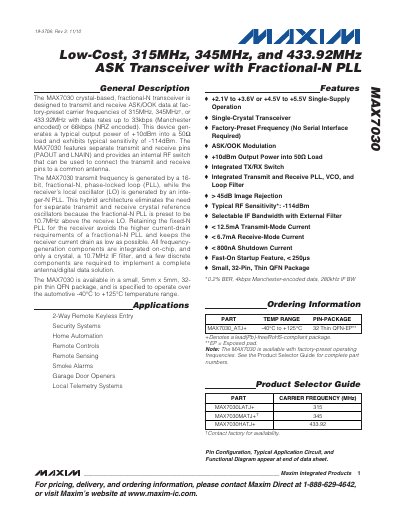
The MAX7030 is a crystal‑based, fractional‑N transceiver designed for ASK/OOK data transmission. It offers factory‑preset carrier frequencies of 315 MHz, 345 MHz or 433.92 MHz, up to 33 kbps Manchester‑encoded or 66 kbps NRZ data rates, and typical output power of +10 dBm into a 50 Ω load. The device integrates separate transmit and receive pins, an internal RF switch, and both transmit and receive PLLs, eliminating the need for external crystal references.
The part is supplied in a 5 mm × 5 mm, 32‑pin thin QFN package and operates over an automotive temperature range of –40 °C to +125 °C. It supports single‑supply operation from 2.1 V to 3.6 V (or 4.5 V to 5.5 V) and features low current consumption, high image rejection, and a selectable IF bandwidth.
| Carrier Frequency Options | 315 MHz, 345 MHz, 433.92 MHz |
|---|---|
| Typical Output Power | +10 dBm into 50 Ω load |
| Typical Sensitivity | -114 dBm |
| Supply Voltage (Single‑Supply) | 2.1 V to 3.6 V (or 4.5 V to 5.5 V) |
| Package | 5 mm × 5 mm, 32‑pin thin QFN |
| Operating Temperature Range | -40 °C to +125 °C |
| Transmit‑Mode Current | < 12.5 mA |
| Image Rejection | >45 dB |
The MAX7030 is available with factory‑preset carrier frequencies of 315 MHz, 345 MHz, or 433.92 MHz.
The device typically delivers +10 dBm output power into a 50 Ω load.
Typical RF sensitivity is –114 dBm.
It operates from 2.1 V to 3.6 V in a single‑supply configuration, or from 4.5 V to 5.5 V for higher‑voltage operation.