
The MAX1471 is a low power, CMOS, superheterodyne, RF dual-channel receiver designed to receive both amplitude-shift-keyed (ASK) and frequency-shift-keyed (FSK) data without reconfiguring the device or introducing any time delay normally associated with changing modulation schemes. The MAX1471 requires few external components to realize a complete wireless RF digital data receiver for the 300MHz to 450MHz ISM bands. The MAX1471 includes all the active components required in a superheterodyne receiver including: a low-noise amplifier (LNA), an image-reject (IR) mixer, a fully integrated phase-locked loop (PLL), local oscillator (LO), 10.7MHz IF limiting amplifier with received-signal-strength indicator (RSSI), low-noise FM demodulator, and a 3V voltage regulator. Differential peak-detecting data demodulators are included for both the FSK and ASK analog baseband data recovery. The MAX1471 includes a discontinuous receive (DRX) mode for low-power operation, which is configured through a serial interface bus. The MAX1471 is available in a 32-pin thin QFN package and is specified over the automotive -40°C to +125°C temperature range.
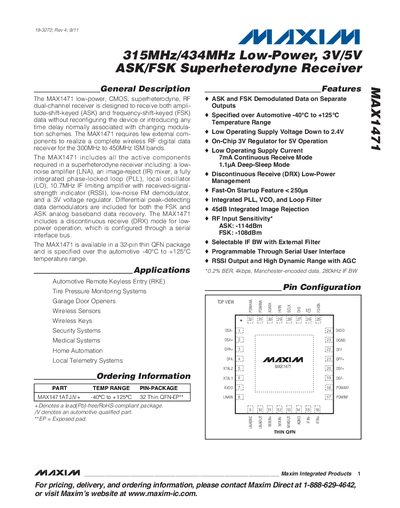
The MAX1471 low‑power, CMOS, superheterodyne RF dual‑channel receiver is designed to receive both amplitude‑shift‑keyed (ASK) and frequency‑shift‑keyed (FSK) data without reconfiguring the device. It integrates a low‑noise amplifier, image‑reject mixer, PLL, 10.7 MHz IF amplifier with RSSI, FM demodulator, on‑chip 3 V regulator and differential peak‑detecting demodulators.
The device is offered in a 32‑pin thin QFN package, operates over an automotive temperature range of –40 °C to +125 °C, and is intended for applications such as automotive remote keyless entry, tire‑pressure monitoring, garage‑door openers, wireless sensors, security and medical systems, and home automation.
| Operating Current (continuous receive) | 7.0 mA typical |
|---|---|
| Deep‑Sleep Current | 1.1 µA typical |
| DRX Mode OFF Current | 5.0 µA typical |
| ASK Receiver Sensitivity | -114 dBm |
| FSK Receiver Sensitivity | -108 dBm |
| Image Rejection | 45 dB |
| IF Bandwidth | 10 MHz (3 dB) |
| Operating Temperature Range | -40 °C to +125 °C |
The MAX1471 is specified for operation from –40 °C to +125 °C.
The ASK receiver sensitivity is –114 dBm.
The maximum receiver input power is 0 dBm.