
The document provides information about the features and characteristics of Alliance Semiconductor P28xx series low-power EMI reduction integrated circuits. These ICs utilize an FCC approved method of EMI attenuation and can provide up to 15 dB of EMI reduction. They generate 1X, 2X, and 4X low EMI spread spectrum clocks based on the input frequency. The P28xx series is optimized for input frequencies ranging from 10 to 40 MHz and includes an internal loop filter to minimize external components and board space. It supports selectable spread options including Down Spread and Center Spread, with low inherent cycle-to-cycle jitter. The ICs operate at 3.3V and are CMOS/TTL compatible. They have a pinout compatible with Cypress CY25811, CY25812, and CY25814. The P28xx series is available for industrial temperature range and comes in 8-pin SOIC and TSSOP packages.
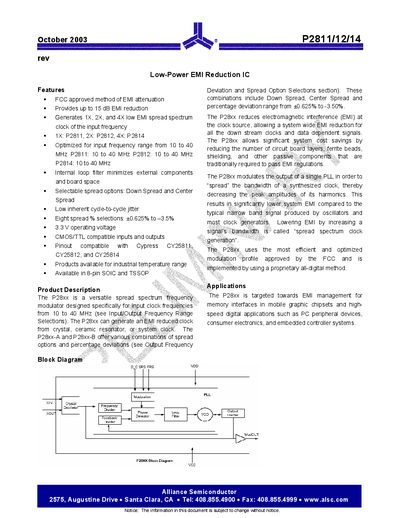
The P2811/12/14 family are low‑power EMI reduction ICs that generate spread‑spectrum clocks to lower peak harmonic amplitudes and meet FCC EMI requirements. They are optimized for input clock frequencies from 10 MHz to 40 MHz and support 1X, 2X, and 4X multiplication modes.
Key features include up to 15 dB EMI reduction, selectable down‑spread and center‑spread options, eight spread‑percentage selections, and CMOS/TTL‑compatible I/O. The devices are offered in 8‑pin SOIC and TSSOP packages and are qualified for commercial, industrial, and automotive temperature ranges.
| Operating Voltage | 3.3 V |
|---|---|
| Input Frequency Range | 10 MHz to 40 MHz |
| Output Frequency Range (P2811) | 10 MHz to 40 MHz |
| EMI Reduction | up to 15 dB |
| Package Types | 8‑pin SOIC and 8‑pin TSSOP |
| Cycle‑to‑cycle Jitter | -200 ps to 200 ps |
It reduces electromagnetic interference by spreading the clock spectrum, providing up to 15 dB EMI reduction.
The device is offered in 8‑pin SOIC and 8‑pin TSSOP packages.
It is qualified for commercial (0 °C to 70 °C), industrial (‑25 °C to 85 °C), and automotive (‑40 °C to 125 °C) temperature ranges.
The IC works with input clock frequencies from 10 MHz to 40 MHz.