
The AS6C1008 is a low power CMOS static random access memory organized as 131,072 words by 8 bits. It is fabricated using very high performance, high reliability CMOS technology. Its standby current is stable within the range of operating temperature. The AS6C1008 is well designed for very low power system applications, and particularly well suited for battery back-up non-volatile memory application. The AS6C1008 operates from a single power supply of 2.7V ~ 5.5V.
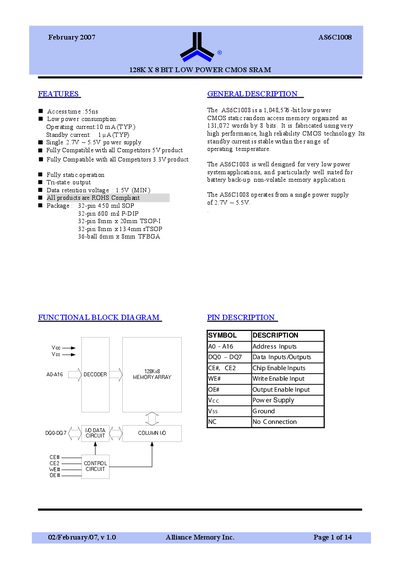
The AS6C1008 is a 128 K×8‑bit low‑power static RAM fabricated in CMOS technology. It operates from a single 2.7 V ~ 5.5 V supply and offers a 55 ns access time with very low standby current.
The datasheet provides pin configurations, absolute maximum ratings, electrical characteristics, timing diagrams, data‑retention specifications, package dimensions, and ordering information for several package options such as 32‑pin SOP, PDIP, TSOP and TFBGA.
| Access time | 55 ns |
|---|---|
| Operating current (typical) | 10 mA |
| Standby current (typical) | 1 pA |
| Supply voltage range | 2.7 V ~ 5.5 V |
| Data retention voltage (minimum) | 1.5 V |
The access time is 55 ns.
It operates from a single supply of 2.7 V to 5.5 V.
The typical standby current is 1 pA.