
AS7C513/AS7C3513 are 5V/3.3V 32K×16 CMOS SRAMs with high speed, low power consumption, 2.0V data retention, TTL compatible, three-state I/O, etc.
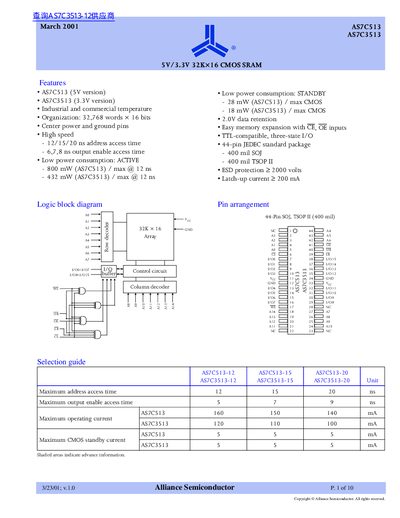
The AS7C513 and AS7C3513 SRAMs are high‑performance 32 K × 16‑bit static RAM devices designed for fast data access, low standby power, and simple interfacing. They support both 5 V (AS7C513) and 3.3 V (AS7C3513) supplies, provide TTL‑compatible three‑state I/O, and include multiple power and ground pins for flexible system design.
Key specifications include address access times of 12 ns, 15 ns or 20 ns (depending on version), output‑enable times of 6 ns‑8 ns, standby power consumption of 28 mW (5 V) or 18 mW (3.3 V), and data‑retention voltage of 2.0 V. The devices are offered in standard 44‑pin SOJ and 44‑pin TSOP II packages.
| Organization | 32,768 words × 16 bits |
|---|---|
| Supply Voltage (AS7C513) | 5.0 V (typical) |
| Supply Voltage (AS7C3513) | 3.3 V (typical) |
| Maximum Address Access Time | 12 ns / 15 ns / 20 ns |
| Maximum Output Enable Access Time | 6 ns / 7 ns / 8 ns |
| Data Retention Voltage | 2.0 V |
The AS7C3513 offers maximum address access times of 12 ns, 15 ns, or 20 ns depending on the version.
A supply voltage of 2.0 V is required for data retention.