
The CYWUSB6935 is a 2.4GHz radio transceiver that operates in the unlicensed Industrial, Scientific, and Medical (ISM) band (2.4 GHz–2.483 GHz). It has a receive sensitivity of –95dBm, an output power of 0dBm, a range of up to 50 meters, and a data throughput of up to 62.5 kbits/sec.
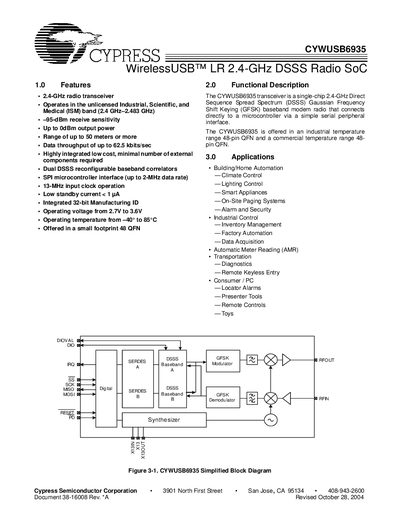
The CYWUSB6935 is a single‑chip 2.4‑GHz DSSS radio SoC that integrates a GFSK modem, dual DSSS baseband, and a programmable PA. It operates in the ISM band (2.4‑2.483 GHz) with up to 0 dBm output power, –95 dBm receive sensitivity, and a data rate of up to 62.5 kbits/sec. The device is offered in a 48‑pin lead‑free QFN package and supports industrial (‑40 °C to 85 °C) and commercial temperature ranges.
The chip provides a four‑wire SPI slave interface (MOSI, MISO, SCK, SS) and an optional DIO SERDES‑bypass mode for high‑speed data transfer. It includes a programmable PA with 30 dB output range, a 13 MHz crystal‑driven synthesizer, RSSI measurement, and a full set of configurable interrupts for transmit, receive, and wake events. All registers are accessible via SPI and are documented in the register map.
| Operating voltage | 2.7 V to 3.6 V |
|---|---|
| Operating temperature | ‑40 °C to 85 °C |
| Receive sensitivity | ‑95 dBm |
| Maximum output power | 0 dBm |
| Data throughput | 62.5 kbits/sec |
| Standby current | < 1 pA |
| Crystal frequency | 13 MHz |
The SPI interface uses four pins: MOSI (Master Out‑Slave In), MISO (Master In‑Slave Out), SCK (Serial Clock), and SS (Slave Select, active‑low).
RSSI values lower than 10 indicate a weak signal, values between 10 and 28 indicate a moderate signal, and values greater than 28 indicate a strong signal.