
This is the specification table of Dytran 3023A6 triaxial accelerometer. It has 4 gram weight, 0.49 x 0.36 x 0.36 inches size, 10-32 tapped hole, 4 pin connector. The accelerometer has +/- 1000g full scale range, 5 mV/g sensitivity, 1.5 to 5000Hz frequency response, 0.0095g equivalent electrical noise, 1%FS linearity and 5% transverse sensitivity.
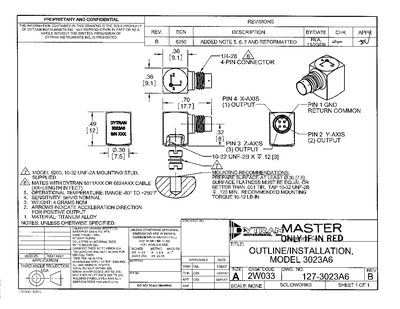
The Dytran 3023A6 is a titanium‑alloy housed tri‑axial accelerometer designed for high‑g applications. It features a 4‑pin connector that mates with Dytran cable assemblies and a 10‑32 tapped mounting hole in the base.
The datasheet lists physical dimensions, sensitivity, frequency response, environmental limits and electrical parameters, enabling engineers to integrate the sensor into vibration and shock measurement systems.
| Weight | 4 grams |
|---|---|
| Size (H×W×D) | 0.49 x 0.36 x 0.36 inches |
| Mounting | 10‑32 tapped hole in base |
| Connector | 4‑pin |
| Housing material | Titanium alloy |
| Range (full scale per axis) | ±1000 g |
| Frequency response (axes 1 & 2) | 1.5 to 5000 Hz |
| Frequency response (axis 3) | 1.5 to 10000 Hz |
| Maximum vibration | ±600 g |
| Maximum shock | 5000 g |
| Operating temperature range | -60 °F to +250 °F |
| Supply voltage (each axis) | +18 to +30 VDC |
| Output impedance | 100 Ω (typ.) |
| Output bias voltage | +10 VDC (nom.) |
| Discharge time constant | 0.3 s (nom.) |
It uses a 4‑pin connector that mates with Dytran cable assemblies.
The device operates from –60 °F up to +250 °F.
It is mounted with a 10‑32 tapped hole in the base.