
SDP10S30 and SDT10S30 are thinQ! SiC Schottky Diodes, which have revolutionary semiconductor material - Silicon Carbide. Their switching behavior is benchmark, no reverse recovery, no temperature influence on the switching behavior, and no forward recovery.
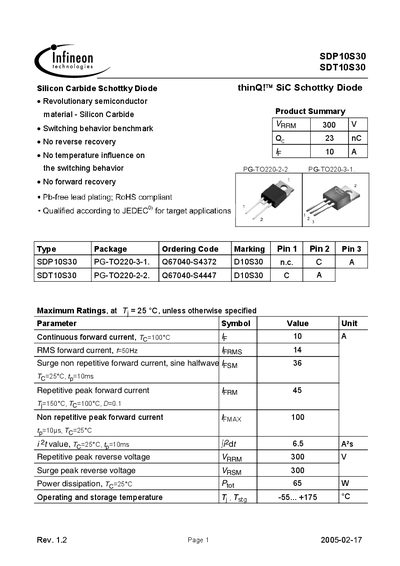
This datasheet provides the electrical, thermal and mechanical specifications for the Infineon SDP10S30 and SDT10S30 silicon‑carbide Schottky diodes. It includes maximum ratings, forward and reverse characteristics, capacitance data and package dimensions.
The document also contains compliance notes, handling warnings and contact information for Infineon Technologies AG. All values are given for a junction temperature of 25 °C unless otherwise noted.
| Continuous forward current (Ir) | 10 A |
|---|---|
| Repetitive peak reverse voltage (VRRM) | 300 V |
| Power dissipation (Prot) at 25 °C | 65 W |
| Operating temperature range | -55 °C to +175 °C |
| Forward voltage at 10 A, 25 °C | 1.5 V (typ) |
The diode can carry a continuous forward current of 10 A.
Both diodes are rated for a repetitive peak reverse voltage of 300 V.
The diode can dissipate up to 65 W at a case temperature of 25 °C.
They are specified for operation from –55 °C to +175 °C.