
MAX4901-MAX4905 low RON, dual-SPST/single-SPDT clickless switches with negative rail capability, can realize distortion-free signal throughput to VCC -5.5V, can be used for headphone detection or mute/send key function.
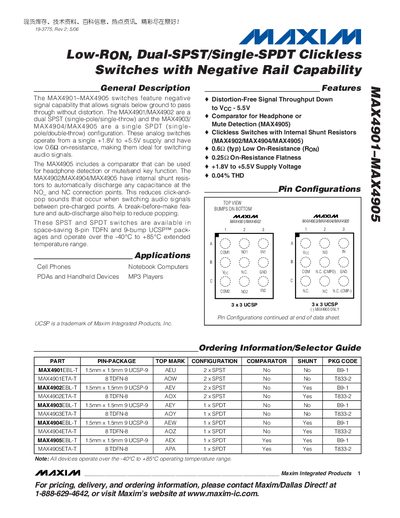
The MAX4901‑MAX4905 family are low‑on‑resistance, dual‑SPST (MAX4901/02) and single‑SPDT (MAX4903‑05) analog switches that operate from a single +1.8 V to +5.5 V supply. They feature negative‑rail capability, break‑before‑make switching and internal shunt resistors to reduce click‑and‑pop when switching audio signals.
MAX4905 adds an on‑chip comparator for headphone or mute detection. The devices are offered in 8‑pin TDFN and 9‑bump UCSP packages and are rated for –40 °C to +85 °C operation.
| Supply voltage range | 1.8 V to 5.5 V |
|---|---|
| Typical on‑resistance (Ron) | 0.60 Ω (typ) |
| On‑resistance flatness | 0.25 Ω |
| Total harmonic distortion (THD) | 0.04 % |
| Operating temperature range | -40 °C to +85 °C |
| Comparator (MAX4905 only) | Included for headphone/mute detection |
| Internal shunt resistor (MAX4902/04/05) | Reduces click‑and‑pop |
| Break‑before‑make feature | Reduces popping sounds |
The devices operate from a single +1.8 V to +5.5 V supply.
Typical on‑resistance is 0.60 Ω.
They are rated for –40 °C to +85 °C.