
The MAX500 is a quad, 8-bit, voltage-output digital-to-analog converter (DAC) with a cascadable serial interface. The IC includes four output buffer amplifiers and input logic for an easy-to-use, two- or three-wire serial interface. In a system with several MAX500s, only one serial data line is required to load all the DACs by cascading them. The MAX500 contains double-buffered logic and a 10-bit shift register that allows all four DACs to be updated simultaneously using one control signal. There are three reference inputs so the range of two of the DACs can be independently set while the other two DACs track each other. The MAX500 achieves 8-bit performance over the full operating temperature range without external trimming.
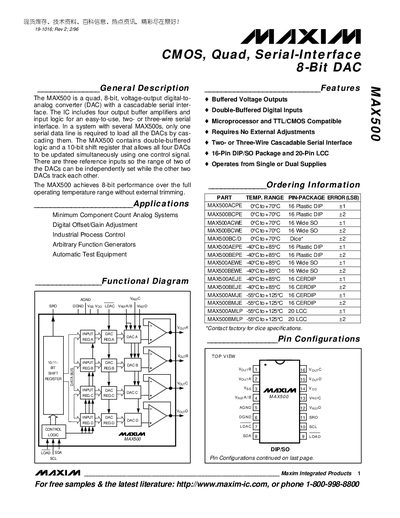
The MAX500 is a quad, 8‑bit voltage‑output digital‑to‑analog converter (DAC) that provides four matched DAC channels with independent or shared reference inputs. It features double‑buffered output amplifiers, a 10‑bit shift register for simultaneous updating, and a cascable serial interface that can operate in either 2‑wire or 3‑wire mode.
The device is offered in 16‑pin DIP, 20‑pin LCC, and wide‑SO packages, supports dual or single supply operation, and includes specifications such as 8‑bit resolution, ±0.3 V absolute maximum ratings, and typical settling times under 4 µs when driving 2 kΩ loads.