
The MAX4999 is a USB 2.0 high-speed differential 8:1 multiplexer from Texas Instruments. It is available in a 32-pin TQFN package and operates from a single +3.0V to +3.6V power supply. The MAX4999 is specified over the -40°C to +85°C extended temperature range.
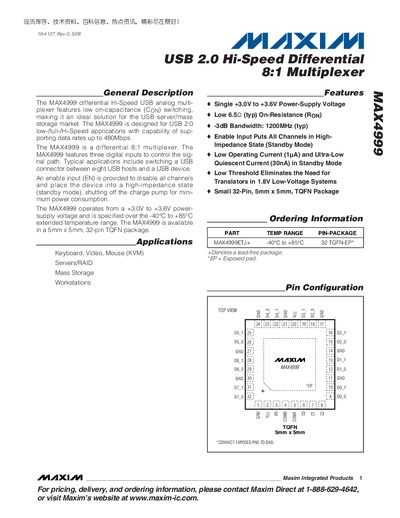
The MAX4999 is a differential 8:1 USB 2.0 Hi‑Speed analog multiplexer designed for server, mass‑storage, and KVM applications. It provides low on‑capacitance and low on‑resistance switching, enabling eight USB hosts to share a single device or allowing two MAX4999s to create a 16:1 configuration.
Key specifications include a 3.0 V‑3.6 V supply range, typical on‑resistance of 6.5 Ω, -3 dB bandwidth of 1200 MHz, and operation from –40 °C to +85 °C in a 5 mm × 5 mm, 32‑pin TQFN package. The device features an enable input that places all channels in a high‑impedance standby mode to minimize power consumption. Proper PCB layout with short controlled‑impedance traces and close bypass capacitors is recommended for optimal performance.
| Supply Voltage | 3.0 V to 3.6 V |
|---|---|
| On‑Resistance (Ron) | 6.5 Ω typ |
| -3 dB Bandwidth | 1200 MHz typ |
| Operating Temperature Range | -40 °C to +85 °C |
| Package | 5 mm × 5 mm, 32‑pin TQFN |
| Enable Input Function | Places device in high‑impedance standby mode |
The MAX4999 operates from +3.0 V to +3.6 V.
It is an 8:1 differential multiplexer, and two devices can be combined for a 16:1 configuration.
When driven low, EN places all channels in a high‑impedance standby mode and disables the internal charge pump.
The typical on‑resistance is about 6.5 Ω.