
MAX492/MAX494/MAX495 are precision low-voltage single-supply operational amplifiers from Texas Instruments. They have wide input and output dynamic range, wide voltage range, low supply current, etc. They are suitable for portable equipment, battery-powered instruments, data acquisition, signal conditioning, etc.
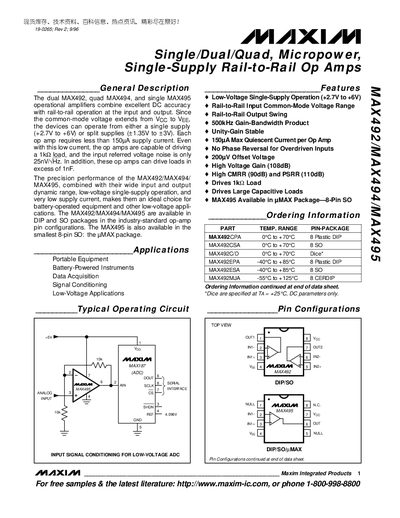
The MAX492, MAX494 and MAX495 are single‑supply, rail‑to‑rail operational amplifiers designed for low‑voltage, battery‑powered applications. They operate from 2.7 V to 6 V, draw less than 150 µA quiescent current per amplifier, and can drive 1 kΩ loads and large capacitive loads.
The document provides absolute maximum ratings, detailed DC and AC electrical characteristics, typical operating curves, ordering information, pin configurations and package dimensions for the three device families in DIP, SO and uMAX packages.
| Operating Supply Voltage Range | 2.7 V to 6 V |
|---|---|
| Quiescent Current (per op amp) | 150 µA max |
| Gain‑Bandwidth Product | 500 kHz |
| Rail‑to‑Rail Input Common‑Mode Range | VCC to VEE |
| Maximum Output Load | 1 kΩ |
They operate from 2.7 V up to 6 V.
The maximum quiescent current is 150 µA per amplifier.
The gain‑bandwidth product is 500 kHz.