
This document describes the features and characteristics of the STP6N25 and STP6N25FI N-channel enhancement mode power MOS transistors, including typical on-resistance, avalanche rugged technology, application areas, etc.
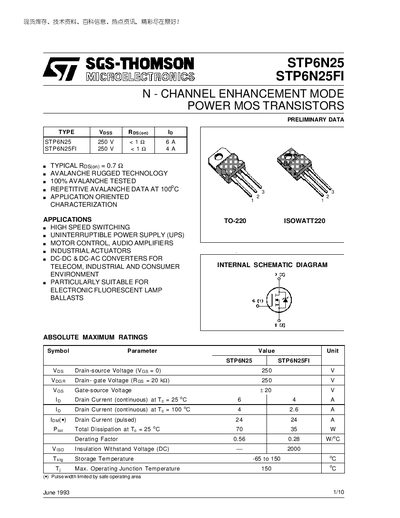
The STP6N25 is a 250 V N‑channel enhancement mode power MOSFET designed for high‑speed switching in applications such as UPS, motor control, audio amplifiers, industrial actuators, and DC‑DC/DC‑AC converters. It features avalanche‑rated technology and is offered in TO‑220 and ISOWATT220 packages.
Key specifications include a continuous drain current of 4 A at 25 °C, a total dissipation of up to 70 W, junction‑to‑case thermal resistance of 1.79 °C/W, and an operating junction temperature limit of 150 °C. Detailed electrical, thermal, and mechanical data are provided for design and reliability assessment.
| Drain‑source Voltage (VDS) | 250 V |
|---|---|
| Gate‑source Voltage (VGS) | +20 V |
| Maximum Operating Junction Temperature (Tj max) | 150 °C |
| Avalanche Current (IAvalanche) | 6 A |
The device is rated for a maximum drain‑source voltage of 250 V.
The part is offered in TO‑220 and ISOWATT220 (surface‑mount) packages.
The device can operate up to 150 °C junction temperature.