
Wanquan 1600B server uses the latest 0.18 micron technology of Intel Pentium IV processor, supports the highest frequency of 2.0GHz CPU, has 400MHz front-end bus, and supports maximum 3GB memory capacity. Three configurations are released to support IDE ATA100, IDE RAID and Ultra160 SCSI technologies. “Low price, safety and efficiency” are its biggest features. It can meet the needs of small and medium-sized enterprises and government departments for mail services, file and printing services, small WEB services, etc. It has good data processing capabilities and a high cost performance ratio, reflecting the design concept of “tailor-made for industry users, with customer needs as the center”. At the same time, Wanquan 1600B has passed the extremely stringent Windows2000 Server compatibility test, and obtained the Microsoft WHQL certification that other brand servers do not have; in professional media reviews, it has outstanding performance, excellent performance, and won the authoritative magazine “Microcomputer World” “Best Product” award, so it is the best choice for domestic small and medium-sized network users.
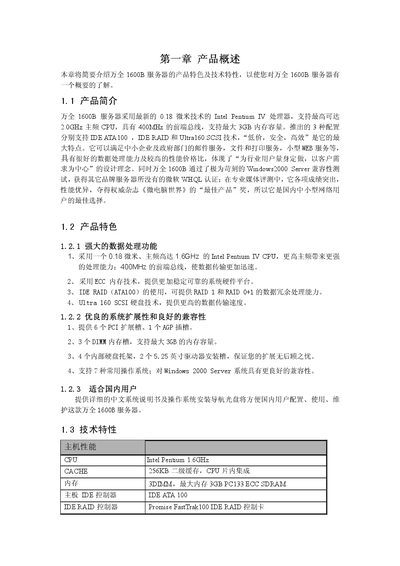
This manual introduces the Lenovo ThinkServer 1600B server, highlighting its Intel Pentium IV processor, ECC memory support, and flexible storage options. It outlines the server's design goals for small‑to‑medium businesses and government use.
The document details hardware installation procedures, component descriptions, safety warnings, and a FAQ section covering common setup and troubleshooting issues such as power‑up problems, CMOS clearing, and drive capacity discrepancies. This manual is written in Chinese.
| CPU | Intel Pentium 1.6 GHz |
|---|---|
| Cache | 256 KB L2 cache |
| Maximum Memory | 3 GB PC133 ECC SDRAM |
| IDE RAID Controller | Promise FastTrak100 |
| SCSI Controller | Adaptec 29160N |
| Power Supply | 300 W ATX12V |
| Dimensions | 470 mm × 210 mm × 505 mm |
| PCI Slots | 6 PCI slots |
| USB Ports | 2 USB ports |
| Network Interface | Intel 10/100 M Ethernet |
Verify that all power cables are securely connected.
Because the BIOS uses binary GB (1024 MB) while the drive manufacturer reports decimal GB (1000 MB), resulting in a lower displayed capacity.