
This document introduces the basic knowledge of LCD construction, working principles, and driving methods, and demonstrates how to drive multiplexed LCD using PSoC technology.
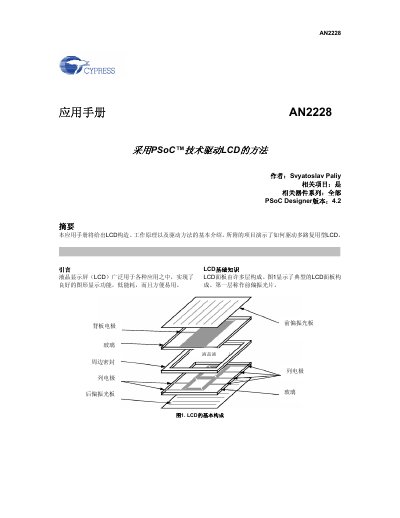
This Cypress application note AN2228 introduces LCD construction, operating principles, and driving methods using PSoC technology. It includes an example project demonstrating how to drive multiplexed LCDs.
Topics covered include LCD basics, polarized light, display modes, temperature effects, drive voltage, static and multiplexed LCD driving, waveform types, and contrast adjustment using PWM. This manual is written in Chinese.
| Drive voltage type | AC only |
|---|---|
| Typical frame rate range | 50 to 150 Hz |
| Maximum temperature | 110°C |
| Nominal operating voltage | 5V |
| Internal capacitance | 5 to 9 nF |
| Project frame rate | 64 Hz |
| PWM output frequency | 93.75 kHz |
LCDs must be driven with AC voltage; DC voltage damages the liquid crystal and destroys the LCD.
The typical frame rate range is 50 to 150 Hz.
Temperatures above 110°C damage the indium tin oxide and polyimide coatings.
The nominal operating voltage is 5V.