
This document describes the maximum ratings, electrical, and thermal characteristics of the FSU20B60 product. The FSU20B60 is a fully molded isolation case ultra-fast recovery rectifier with features such as low forward voltage drop, low power loss, and high efficiency. It is suitable for power factor improvement and high-frequency rectification.
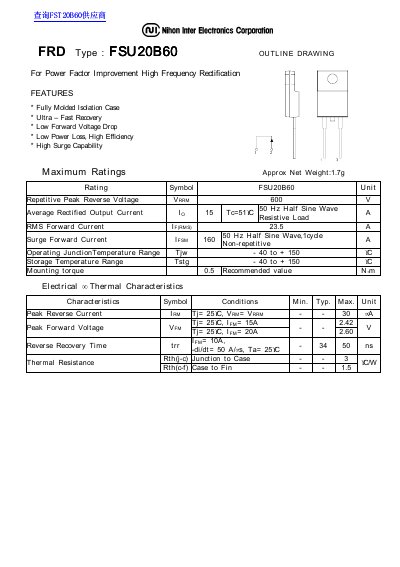
This document is a technical datasheet and outline drawing for the FSU20B60, an ultra-fast recovery power diode manufactured by Nihon Inter Electronics Corporation. It is designed for high-frequency rectification applications requiring power factor improvement.
The datasheet provides maximum ratings, electrical characteristics, thermal data, and physical dimensions. Key features include a fully molded isolation case, low forward voltage drop, and high surge capability.
| Repetitive Peak Reverse Voltage | 600 V |
|---|---|
| Average Rectified Output Current | 50 A |
| RMS Forward Current | 23.5 A |
| Surge Forward Current | 160 A |
| Operating Junction Temperature Range | -40 to +150 °C |
| Reverse Recovery Time (Typical) | 34 ns |
The maximum repetitive peak reverse voltage is 600 V.
The average rectified output current is 50 A at a case temperature of 51°C.
The recommended mounting torque is 0.5 Nm.