
This document describes the impact of power losses in output rectifiers on efficiency in power supplies, and how to select low forward voltage Schottky diodes with optimal performance.
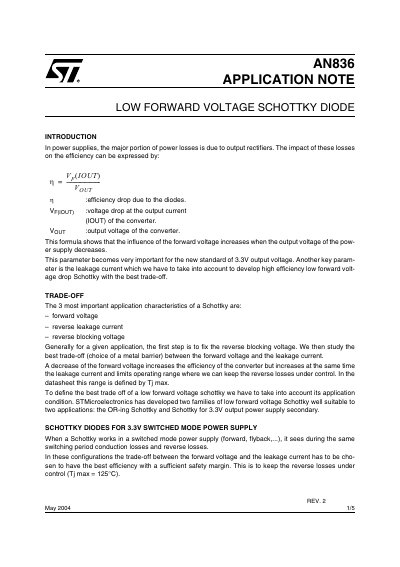
The document explains that in power supplies, output rectifier losses significantly impact efficiency, particularly as output voltages decrease to standards like 3.3V. It highlights the critical trade-off between forward voltage (which affects efficiency) and reverse leakage current (which affects thermal performance).
| Reverse Blocking Voltage (25V Family) | 25V |
|---|---|
| Maximum Junction Temperature | 125°C |
| Reverse Blocking Voltage (OR-ing Family) | 10V or 15V |
A decrease in forward voltage increases efficiency but simultaneously increases leakage current, which limits the operating range where reverse losses remain under control.
A breakdown voltage of 10V is considered sufficient for output voltages of 5V and 3.3V.