
This document discusses the Tj max limit of SCHOTTKY rectifiers specified in the datasheet, explaining the true meaning of this parameter and why the component can operate with a junction temperature higher than Tj max in certain applications. The document also describes the thermal runaway phenomenon that causes the lower Tj max limit and provides rules for calculating the limit before thermal instability is reached. Two examples are provided to illustrate how different conditions can lead to different Tj max limits for the same diode.
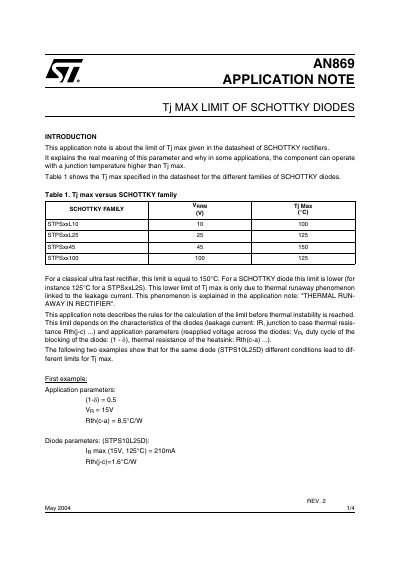
This document is an application note regarding the maximum junction temperature (Tj max) specified in datasheets for various families of STMicroelectronics Schottky rectifiers. It clarifies that this limit is primarily due to a thermal runaway phenomenon linked to leakage current, rather than just material constraints.
The text provides specific Tj max values for different diode families and details the rules for calculating the temperature limit before thermal instability occurs. It includes two calculation examples demonstrating how application parameters, such as reverse voltage and heatsink thermal resistance, influence the safe operating junction temperature.
| Tj max for STPSxxL10 family | 100°C |
|---|---|
| Tj max for STPSxxL25 family | 125°C |
| Tj max for STPSxx45 family | 150°C |
| Tj max for STPSxx100 family | 125°C |
The lower limit, such as 125°C for some families, is due to a thermal runaway phenomenon linked to leakage current.
No, it depends on both diode characteristics and application parameters like reapplication voltage and duty cycle.