
This application note introduces the thermal runaway characteristic of the Schottky diodes used in OR-ing applications
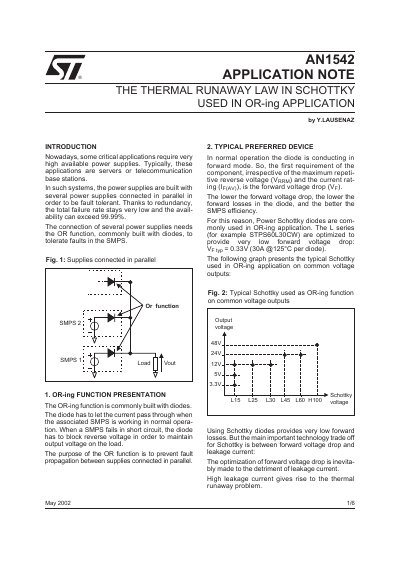
The document discusses the use of parallel power supplies in critical applications like servers, which require an OR function typically built with diodes. It highlights that while Power Schottky diodes offer low forward voltage drops for efficiency, they suffer from high leakage current that can lead to thermal runaway when blocking reverse voltage.
The note details the physics of thermal runaway, where increasing junction temperature leads to higher leakage currents and further heating. It presents a method to quantify this risk by comparing forward losses before a supply failure against reverse losses after the fault. The document concludes with optimization strategies for STMicroelectronics' 'L' family diodes (e.g., STPS40L15C) to improve SMPS efficiency while controlling thermal runaway risks.
The optimization of forward voltage drop is inevitably made to the detriment of leakage current, which can cause thermal runaway.
High reverse current generates high reverse losses, increasing junction temperature and thus reverse current further until failure.
The 'L' family demonstrates very low forward voltage in order to reduce conduction losses.